Sunday, 8 March 2015

Make It Happen

To celebrate International Women's Day this year I attended the All About Women festival at the Sydney Opera House with a dear friend.

The theme of IWD this year is 'Make It Happen' which I quite like as a variation of the Picardian 'Make It So'. The question of course is What do we need to make happen? Gender equality? Equal pay for equal work? Reproductive freedom? Equitable representation? Stopping domestic violence? Etc etc. Yes, all of these and more. So days like today serve as a reminder that equality has not yet happened, and that feminists still have a lot of work to do.

There were a lot of sessions to chose from at All About Women, and unfortunately I could not see them all. Here are my highlights:

My day started with a session by Brigid Schulte called 'Overwhelmed: Stop Doing It All". Schulte is a Pulitzer Prize winning journalist and author of Overwhelmed: Work, love and play when no one has the time (2014). She began her research into leisure time when her paper was wondering why female readership had dropped. She asked a time specialist who told her she has 30 hours of leisure time a week - which she found hard to believe as she was juggling a career and family and feeling guilty about competing demands. Schultz was funny and open and offered a lot of insight into neuroscience, cultural norms and how to reclaim a bit of time for ourselves. After the session my friend and I got to chat with her as she signed books for us. It was lovely to meet her and I can't wait to read her book.

Next up was a session called Bad Feminist (2014) with Dr Roxane Gay, author of a collection of essays by the same name. I started reading this delightful book last week in anticipation of hearing her speak. I loved this session, and it was definitely the best of my day at the festival. Gay is a really interesting, straight talking, no BS bad feminist. I really liked the way she answered questions and was unapologetic in her views. For example, she was asked if someone who is pro-life can be a feminist, and Gay said no because that person denies the choice of other women. She also stated that women do not need to hold hands and bring men on the feminist journey - she said they need to figure it out themselves.  Gay has also recently released a novel called An Untamed State (2015) which I look forward to delving into.

My final session of the day was 'Women Warriors' looking at women in the military chaired by Catherine Fox, talking with Major Charmaine Enfield, Commander Cath Hayes, Wing Commander Fleur James, and Alex Shehadie.  Fox is author of Seven Myths about Women and Work and I have heard her speak a number of times at the Festival of Dangerous Ideas and elsewhere. It was great to hear from these amazing women, but somehow this session fell a bit flat for me. I thought there would be more to it - a bit more warrior - but this was lacking. But the women themselves were admirable.

There were of course a lot of sessions I didn't get to that I would have like to. Annabel Crabb spoke about her book The Wife Drought (2014) and I had the good fortune to meet Annabel at the book signing. Australian of the Year Rosie Batty spoke about domestic violence. Helen Garner was on hand to talk about This House of Grief (2014), which I would have liked to have seen given that this book was my favourite non-fiction of 2014, but it conflicted with other parts of the schedule. I also would have liked to hear from Anita Sarkeesian in her presentation called 'Gamergate and Beyond: Women in Popular Culture."

So IWD is over for another year, but I have plenty of books to keep me occupied until the next one!


Saturday, 21 February 2015

You are what you eat

I love food. I think about eating a lot. I try to be conscious of what is in my food and regularly read the labels to contemplate sodium and fat levels, but I get bamboozled by mysterious ingredients. My main concern, as a vegetarian, is that what I eat contains no meat. So I have always considered myself a fairly conscientious eater.

My aunt (who is vegan) encouraged me to read Michael Pollan's The Omnivore's Dilemma (2006) and I have just finished reading this fascinating book.  It has made me look at food in a whole new way. In fact, just this morning, I was at my local farmer's market checking out organic products and contemplating my food choices.


So what is the omnivore's dilemma? Pollan describes it as follows: "It boils down to this: As creatures who can eat many different things, how do we know what's good to eat and what's not?" (p.60) Exactly! How do we know what we are consuming?


The Australian government has recently released a new front of package Health Star Rating system which is designed to help consumers select foods that are better for us. The stars tell is the energy, saturated fat, sugars, sodium and iron content in the food peer 100g allowing us to compare foods as we buy them. I think this is great and it will go a long way towards helping people choose healthier options.


But Pollan takes this a step further and asks us to consider the whole food chain - from farm to table. He does so by telling the story of four meals.

First, he begins with the industrial food chain by taking us to a large corn plantation where corn is mass produced. I had no idea just how much corn is in everything we eat in various forms. "If you count all the corn we eat, directly and indirectly the average American eats a ton of corn every year. We don't recognise it as corn, though, because it's been turned into something else." (p 49)

He then takes us to an industrial organic lettuce plantation, where organic food is mass produced for grocery store chains. I was surprised about some aspects of this type of organic farming, including the allowable pesticides and the fossil fuel usage.

Pollan then moves on to a local organic farm and spends a week with the family, participating in all their activities. This was perhaps my favourite section of the book, as the family lovingly cared for their animals allowing them to live and die with dignity. Here Pollan raises and interesting point about how much we are willing to pay for high quality local food when he points out people grumbling about paying an extra dollar for farm fresh eggs. "Nowadays many Americans are even willing to pay for water - something we can get for free from any tap. So why are we unwilling to pay more for better food."(p123)

The final section sees Pollan trying to cook a meal that he has hunted and gathered himself. This section I probably enjoyed least as the idea of hunting for meat was off-putting (although I do know the delicious sweet taste of fresh chanterelles, having once had them picked fresh in Scotland).

Overall I really enjoyed this book and it has got me thinking more about what I eat, where it came from and how I can make better choices.


Sunday, 15 February 2015

Miss Manners

Hot on the heels of reading Lena Dunham's memoir, I immersed myself in Amy Poehler's Yes Please (2014). It is a light, witty confection of a book, which is pulled together by loose threads and scrapbooked memories.

In some respects it is strange to choose to read a memoir of someone I don't really know that much about. I was not one of Amy Poehler's fans - for whom this book is clearly aimed. While I admired her sketch comedy on Saturday Night Live, I only ever watched that show occasionally and can't really recall any of her characters. I love her award hosting duties with Tina Fey but I would have said I was a Fey-fan. I have not seen Parks and Recreation (...yet) and her other work (Deuce Bigalow, Baby Mama) isn't really my thing. Reading her book, however, I suddenly felt like her biggest fan!

Amy (I can call her that because she feels like a BFF to me now) recalls her childhood in Boston, her early days in improv, the Upright Citizens Brigade, SNL, and the highs and lows along the way. It was instantly relatable to me as I grew up in the same period, not far away, so the pop culture references made me smile knowingly.

I admire the way she wrote about her family, her divorce and the time she apologised for an insensitive comedy sketch. I love her feisty, feminist life lessons, her no bull attitude, and her "good-for-you-not-for-me" approach to life. She is not afraid to share cringeworthy stories about some of her mishaps, and in doing so readers will laugh as they have done them too.

In terms of a memoir, Yes Please is exactly what I thought it would be - a 'how I got here from there' tale with some witty anecdotes and occasional deep-and-meaningful moments. I didn't really need to know Poehler's work in order to read the book, but now that I have read it I am off to binge-watch Parks and Rec!

Sunday, 18 January 2015

Girl, Interrupted

Lena Dunham is an incredibly interesting young woman. The creator of HBO series Girls, I greatly admire Dunham's creativity as a writer and director in crafting a show for and about twenty-something feminist women struggling with life in New York.

She recently published her first memoir - Not that Kind of Girl: A Young Woman Tells You What She Has 'Learned' (2014) - which contains Dunham's reminiscences loosely grouped in sections titled Love & Sex, Body, Friendship, Work, and Big Picture. In a series of essays Dunham explores various vignettes from her life, separated by snappy lists ('15 things I learned from my mother'), in a non-linear, disorderly manner. The book has attracted a fair amount of controversy for some of its contents, and for the multi-million dollar advance given to the author.

Readers wanting to know how a young woman achieved such success as a filmmaker will not find it here. In fact, those seeking to emulate her creative journey will be none the wiser. I was hoping to learn what inspired her and how she has managed her success. Instead I learned too much about Dunham's narcissism and neuroses.

Dunham writes that she lives "in a world that is almost compulsively free of secrets." She puts herself out there - emotionally, physically, artistically - and there is a lot to admire about that. But at the same time I kept wishing that she was more self-protective. Do we need to hear about every sex act she has performed? Does she realise how privileged she sounds? Is she making up these stories anyway?

There is humour here and there (not dissimilar to Girls in that respect) and there are moments of depth and insight. But largely I felt disappointed by Not That Kind Of Girl because it was Not That Kind of Memoir. Perhaps that was my problem - hoping it would be something it wasn't.

Tuesday, 13 January 2015

Arsenic and Old Lace

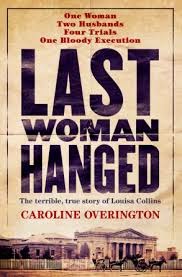
Last Woman Hanged (2014) by Caroline Overington tells the true tale of Louisa Collins, convicted murderer who was executed in Sydney in 1889. Found guilty of poisoning her second husband Michael Collins with arsenic, Louisa was hanged, leaving her young children in the care of the State.

Louisa was born in Belltrees near Scone, NSW and was married at nineteen to local butcher Charles Andrews. She spent much of the next twenty years pregnant with the nine children she would bear. Possibly ill-matched, Andrews was a committed family man who adored his wife, while Louisa perhaps missed out on many experiences that she would have enjoyed in lieu of domesticity.

When the couple moved to Botany in 1886 so that Andrews could work as a wool-washer, they took in boarders to make ends meet. Rumours circulated in the tight Botany community that Louisa enjoyed drinking with the men who stayed in their home.

In early 1887 Andrews took ill and after a few days of excruciating pain he died. Louisa's behaviour immediately after his death was viewed unfavourably by police and local gossips, especially as she did not don mourning clothes and applied for access to Andrews life insurance. Within two months of being widowed, Louisa married Michael Collins, a former boarder, pregnant with his child.

Collins was not good with money and the insurance funds dissipated quickly. Their infant son John died, and Louisa's older children were not fond of their new stepfather. In mid-1888 Collins took ill, with symptoms similar to Andrews, and died on 8 July. Almost immediately Louisa was arrested for his murder by poisoning.

What happened next was appalling. Louisa Collins was tried - four times - by a prosecution determined to convict. The evidence against her was entirely circumstantial and there was much to suggest that both men may have became poisoned through their work as wool washers as skins were treated with arsenic. She had an extremely ineffective defence attorney and her young daughter May was compelled to give evidence against her. The first three trials resulted a hung jury, but the last, with a backdrop of media frenzy, voted to convict. These four trials occurred in rapid succession with gross misconduct on the part of many of the judges.

Overington combs through the evidence for and against Louisa and highlights many inconsistencies which lead the first three juries to be unconvinced of her guilt beyond reasonable doubt. She also explored the historical context of the rise of the women's suffrage campaign, the temperance movement and the sensationalism of the media. What emerges is a travesty of justice in which a woman was killed by the State in a most horrific way.

This book was intriguing in many respects with Overington's skills as a journalist lending weight to her research. I particularly enjoyed the story of the early feminism in Australia. I learned a great deal about how autopsies were performed in hotels, the travel by tram around Sydney, and about the medical fraternity of the time. Although I need no further evidence to support my stance against capital punishment, this book was a reminder of how State-sanctioned killing is immoral and unjust.

I did not particularly like Overington's writing style, however, and felt that some of her turns of phrase distanced me from the content. She included many asides where she presented information with a modern gaze, and would have been better off sticking purely to the facts. An example is when she was talking about Alexander Green, one of the first hangmen in NSW. Overington writes "like most normal people, Green did not set out to become a hangman...". This sentence jarred me as judgemental and unnecessary. Later she writes about Louisa's fate moving to Parliament house "... in about the time it took to traverse the distance by foot. Well, not quite, but the point is made." The point could have been made without the poor analogy. This occurred regularly throughout the book and I wished it had been better edited prior to publication to remove some of these clunky asides.

But overall I am pleased that I read the book and had a glimpse of this time in our history. This book is recommended to those with an interest in history or the judicial system.

Sunday, 4 January 2015

Larger than Life

The latest Quarterly Essay (QE56) by Guy Rundle is Clivosaurus: The Politics of Clive Palmer (November 2014). An intriguing tale of a politician and a flawed political system, Rundle has written a witty, pithy account of Palmer's political rise and what he may mean for Australia and our political system.

In 2013 Clive Palmer - Queenslander, self-proclaimed billionaire, mining magnate, dinosaur enthusiast and Titanic-fan - formed his own political party and sought appointment as the member for Fairfax in the federal election. The Palmer United Party (PUP) was initially dismissed by the media and the mainstream parties as a sideshow without any chance of winning, but surprised many by securing one seat in the House of Representatives and two in the Senate. Canberra hasn't been the same since...

A larger-than-life figure, Palmer has always seemed to me to be a bit of an eccentric, bumbling clown - thumbs-upping in photo shoots, making up policy as he goes along and generating publicity stunts. Whether it is through his twerking on TV, storming out of interviews, or his policy flip-flops, I could never seem to get a handle on who Clive Palmer is, and what he hopes to achieve. I cynically presumed he took to politics to further his own ego and to serve his own ends (like reducing taxes on mining companies). In this essay, Rundle attempts to get to the heart of the mystery - who is Clive Palmer?

Along the way we learn about Palmer's upbringing, his business ventures and his poetry (Rundle drew heavily from Sean Parnell's Clive - The Story of Clive Palmer (2013) to flesh out Palmer's backstory). This was extremely interesting and presented Palmer as a much more complex character than I had given him credit for. While Palmer's philosophy and politics do not align with mine, and I am still very sceptical about his motives, I can no longer write him off as merely a media-hungry buffoon.

Rundle's essay also exposes the flaws of the Australian political system - which is marred by loop-holes and complexities. The number of fringe candidates, satirical parties, and outright odd-balls that make it on to the ballot (and worse still into Parliament) is evidence of a system that needs review. The system can be gamed, with 'preference-whisperers' and backroom deals, resulting in the election of people with very low primary votes. But this is not new, rather it is a known problem that no one seems willing to tackle.

Illuminating the 'triple lock' of the Australian system - compulsory voting, preferential voting and taxpayer campaign funding - Rundle shines a light on areas that need to be urgently addressed. He calls for an open discussion about creating a more democratic system and lists items for inclusion in this debate (voluntary voting, multi-member electorates, optional preferences, campaign spending, role of the governor general). I whole heartedly agree.

Clivosaurus was another excellent essay in this series. My reviews of past Quarterly Essays are also on this blog:

Thursday, 1 January 2015

Planning for 2015

It is never wise to plan my reading for the year. As soon as I decide what I am going to read, I get distracted by new novels and non-fiction that is published throughout the year and by books I find lurking on my shelves waiting for their time to be read.

But I do have a overall plans to try and read at least two books a month (so 24 for the year). I would like to try and vary my reading some more and tackle some of the books I have recently been given.

Biographies are always enjoyable. I like hearing of how other people have lived and the challenges they have overcome. The biographies I have on my to-be-read pile include:

I guess that list says something about my admiration of strong, brave, funny, feminist women. However, I may throw in a volume by Stephen Fry along the way.

In addition to biographies, my keen interest (as always) is political economy - with special attention to social policy, wealth inequality, and gender issues. On my list for 2015 are:
  • A Bigger Prize (2014) by Margaret Heffernan
  • Slavery Inc - The Untold Story of International Child Sex Trafficking  (2010) by Lydia Cacho 
  • The Omnivore's Dilemma (2006) by Michael Pollan (Update: read February 2015)
  • Capital in the Twenty-First Century (2013) by Thomas Piketty
  • Quarterly Essay 56 - Clivosaurus (2014) by Guy Rundle  (Update: read January 2015)
  • Quarterly Essay 55 - A Rightful Place (2014) by Noel Pearson
  • Quarterly Essay 54 - Dragon's Tail: The Lucky Country After the China Boom (2014) by Andrew Charlton
I will have another year's worth of Quarterly Essay arriving and other non-fiction to add to this list as I go along.

In terms of fiction, my to-be-read pile changes regularly as I am often taken by a theme or an author or dip back in to re-read an old favourite (such as my annual Harry Potter spree!). On the list are:


  • The Paying Guests (2014) by Sarah Waters
  • All the Birds, Singing (2013) by Evie Wyld
  • Nora Webster (2014) by Colm Toibin
  • Top Secret Twenty-One (2014) by Janet Evanovich 
  • A Feast for Crows (2005) by George R R Martin - fourth instalment of Song of Ice and Fire series.
  • World of Wonders (1975) by Robertson Davies - final instalment of the Deptford Trilogy which is a long overdue read.

  • Add to this list some of the new books expected from Kazuo Ishiguro (The Buried Giant), Anne Tyler (A Spool of Blue Thread), Irvine Welsh (A Decent Ride), and hopefully a new Robert Galbraith.

    So overall it looks like a great year for reading. Can't wait!

    Wednesday, 31 December 2014

    My 2014 in books

    I have enjoyed my reading in 2014, and again tried to balance my fiction and non-fiction reads as well as taking on new authors that I have not read before. I had hoped that the year would be a better one for reading and blogging, and overall I think it has been.

    In January I wrote that my priority was  to finish books that I had already started, which included:

      • Oryx and Crake (2003) by Margaret Atwood (Update - Read Jan 2014
      • Mortality (2012) by Christopher Hitchens (Update - Read Feb 2014)
      • The Cuckoo's Calling (2013) by Robert Galbraith (JK Rowling) (Update - Read Sept 2014)
      • A Sport and a Pastime (1967) by James Salter
      • World of Wonders (1975) by Robertson Davies
      • A Feast for Crows (2005) by George RR Martin
      • Wolf Hall (2009) by Hilary Mantel
      • And the Mountains Echoed (2013) by Khaled Hosseini
      • The Getting of Wisdom (1910) by Henry Handel Richardson
      • The Slap (2008) by Christos Tsiolkas

      I managed to only finish three of those books (Atwood, Hitchens and Galbraith) as I was tempted away by others. While I started and stopped all of the others, they did not hold my interest at the time but may be revisited again in the future.

      Instead, I read the following in 2014, in addition to those listed above:

      In terms of fiction, it seems as though I read a few books on dysfunctional families, including those by Tartt, Tyler, Steadman and Sedaris. Each different in their own ways, but all demonstrating how families can move from places of love and security to fear and loathing. Of these books, Tyler's Dinner at the Homesick Restaurant was the stand-out for me - beautifully written, well crafted story. 

      While I continued to read Evanovich's Stephanie Plum series, I have been keen to find another series to sink my teeth into. JK Rowling's move into crime novels has been most welcome. I loved her writing as Robert Galbraith and consumed both The Cuckoo's Calling and The Silkworm in rapid succession.  I look forward to reading more of this series once Rowling has a chance to put pen to paper. 


      In terms of non-fiction, Kajsa Ekis Ekman's book on prostitution and surrogacy was an eye-opener and I was keen to read this after having heard her speak at the Festival of Dangerous Ideas.  I have also greatly enjoyed reading the Quarterly Essay this year and have written blog entries about two of the titles I have read:
      In addition, I  reviewed the Sydney Theatre Company production of Macbeth which I attended in September 2014.

      My 2014 highlights were two books by Australian authors.

      Richard Flanagan's Booker prize winning The Narrow Road to the Deep North was a stunning read and one I have thought about almost daily since finishing. I was so deeply touched by this story of love and war.

      Helen Garner's non-fiction account of a murder trial, This House of Grief, was also a compelling read. The story of how Robert Farquharson was tried for drowning his three sons in a dam in rural Victoria was heartbreakingly brilliant.

      Overall, I had a good year for reading and I have a number of books to tackle in 2015...

      Monday, 29 December 2014

      Father's Day

      On Father's Day in September 2005, a man was driving his three sons through rural Victoria to his former marital home. His car veered off the road, through a fence and into a deep dam. The man escaped, but Jai (8), Tyler (6) and Bailey (2) drowned in the murky dark waters.

      Over the next eight years Australian author Helen Garner would sit through two murder trials which would ultimately find the man, Robert Farquharson, guilt of murder and sentenced to three life sentences - a minimum of 33 years imprisonment. Garner's experience is documented in This House of Grief (2014), a gripping true crime account in which she empathises with everyone involved in this tragedy. 

      Farquharson, claimed he was struck by a sudden coughing fit and blacked out at the wheel, awakening once the car was plunging to the bottom of the dam. In contrast the prosecution presents a premeditated crime to get back at his ex-wife for leaving him.

      Garner describes Farquharson as a bumbling, coddled, man-child, who clearly loved his kids but was at a loss when his wife left him. His ex-wife Cindy Gambino stood by him during his first trial, protesting that this was a horrible accident. By the retrial,  her perspective changes and Gambino comes to a view him as a vindictive, embittered man, determined to take away the only thing that really mattered to her.

      An incredible observer, Garner picks up the minute details of the case. From the fatigue of the jurors, the resolve of Gambino's parents and the resilience of barristers on both sides, Garner documents this first person account of how the murder trials unfolded. She describes how the trial seeped into her daily life and caught her unawares at the greengrocers, when holding her grandson, at the coffee cart outside the courts, and in after court drinks with colleagues.

      I am generally not a fan of true crime books, as they often tend to glorify and revel in the gory details. But Garner is a masterful writer with a keen bullshit detector who is able to create a compelling story of the human side of this tragedy. She wrestles with the case as the jury might and continually looks for the doubt in the evidence presented. The duelling experts, the tedium of the technical details of tyre tracks and car speeds, the guilt felt by family friends, the description of expected behaviour for those affected by trauma. Above all, she presents a compelling case for the rule of law - a story that resonated with me and recalled my law school days pouring over case notes and observing in court rooms.

      I am a huge admirer of Garner's work - in fact her Joe Cinque's Consolation (2004) about a Canberra murder trial is one of the most amazing books about the law that I have ever read. She did not disappoint with her account of the Farquharson case, which I consumed in a mere three days after receiving it for Christmas. At the end of the book we are left with a reminder that three young lives have been lost, two families have been shattered, and a comity has been torn apart.  All of us, however removed from this tragedy, are touched by this terrible loss and grieve in our own ways.

      Monday, 15 December 2014

      Family Ties

      In 2004 David Sedaris published his collection of semi-autobiographical short stories, Dress Your Family in Corduroy and Denim. As he depicts vignettes from his childhood in North Carolina, through to his adult life in New York and Europe, Sedaris shines a spotlight on his family and highlights the absurdity of so many family interactions.

      Funny, touching, bizarre and bitchy, Sedaris doesn't hold back in depicting his parents, siblings and partner. Whether describing his boofhead brother's wedding in 'Rooster at the Hitchin Post', or the hoarding of one of his sisters in 'Put a Lid on it', Sedaris is brutal. Whether he is brutally honest is another matter - I suspect there is more than a little bit of artistic licence taken.

      There are plenty of touching moments too - particularly in relation to his homosexuality. Clearly his father had difficulty accepting his eldest son, kicking him out of the house. His brother routinely calls him names. He is inundated by hate when listening to talk back radio. Among the name calling and shame, life lessons emerge. He peppers his tales with truisms such as 'Boys who spent their weekends making banana nut muffins did not, as a rule, excel in the art of hand-to-hand combat.'

      Perhaps what makes Sedaris interesting is that he is such an unlikely character himself. Neurotic, obsessive-compulsive, unsympathetic, Sedaris is a wonderful humourist who makes readers uncomfortable when describing his own discomfort.

      I have previously reviewed Sedaris' Squirrel Seeks Chipmunk: A Wicked Bestiary on this blog.

      Saturday, 6 December 2014

      Casualties of War

      I have just finished Richard Flanagan's The Narrow Road to the Deep North (2013) and am absolutely in awe of this magnificent novel and want to share it with everyone I know. A worthy winner of the 2014 Man Booker Prize, Flanagan has created a compelling story of love, mateship and war.

      Dorrigo Evans is a young Australian doctor who heads off to war. Before he departs for the front, he meets and falls in love with Amy - the young wife of his uncle Keith. He travels to Europe and then Asia, ending up a prisoner of war on the Thai-Burma Railway, and all the while he dreams of a life with his beloved.

      Because he is a surgeon, Dorrigo's job is to care for the men and ensure they are fit enough to work the line. Each day he counts out  hundreds of men, from an ever diminishing pool, fit enough to haul timbers, break rocks, and clear the dense jungle for the ill-fated railway. Suffering from starvation, ulcers, lice, cholera, beri-beri, malaria and broken limbs - those who can stand must work. Dorrigo knows that he is sending many to their deaths and he performs a delicate dance with his captors to negotiate on the men who will serve.

      In the camps we hear about Rooster McNeice, Jimmy Bigelow, Darky Gardiner, Bonox Baker, Sheaphead Morton, Tiny Middleton, Gallipoli Von Kessler and others - and witness Australian mateship in its truest form. Tiny acts of defiance, kindness and love sharply contrast with the barbarity and horror of the war. Those who returned were never the same - suffering trauma that impacted their lives, livelihoods and the people who loved them. We also learn the fate of Colonel Kota, Major Nakamura, and other Japanese and Korean prison guards and get some insight into their views of the railway: their commitment to serving the Emperor, their sense of honour and their post-war reflections.

      Told in a non-chronological order - the book jumps back and forth between the pre-war days, the POW period and the aftermath of war with the war crimes trials and Dorrigo's unwanted fame. The novel is littered with haiku from poets Issa, Buson and Basho - the latter providing the book's title. The simplicity and beauty of these brief verses are juxtaposed with the brutality of war and provide a glimmer of hope.

      My heart broke many times during this story - with the tale of Darky Gardiner, Ella's unrequited love, the Tasmanian bushfire, the letter that changed fates and many other moments on the line. It is not an easy read but it is compelling.

      Flanagan dedicated the novel to his father, who was POW on the railway. While this is not the story of Flanagan senior, it was certainly inspired by him and also by Edward 'Weary' Dunlop, an Australian hero of the camps. I learned a lot about the death railway through this book and it inspired me to seek out more information. Over 60,000 POWs from Britain, Australia, America, Holland and elsewhere worked on the railway and around 16,000 died from the physical labour, disease, starvation, and beatings while working the line.

      I have read many of Flanagan's previous novels - including The Sound of One Hand Clapping (1997), The Unknown Terrorist (2006) - and have consistently been impressed by his abilities to create full characters and reflect the beauty of the Australian landscape. In this novel, Flanagan's prose creates a vivid portrait of love and war. I am so pleased the Booker was awarded for this novel.

      Shortly after completing this book I watched the film of The Railway Man (2013) based on the life of British engineer Eric Lomax. He was imprisoned in the death railway camps in 1942 and tortured for building a radio. He returned home a broken man and in old age sought out one of his captors. Starring Colin Firth and Nicole Kidman, it was a good film with solid performances. However, I felt that it didn't give the depth of experience and appreciation of the trauma that Flanagan's novel provided.

      Saturday, 8 November 2014

      Mightier than the Sword

      Immediately upon finishing The Cuckoo's Calling, I found myself immersed in the next Cormoran Strike adventure. The Silkworm (2014) commences a few months after Strike has been lauded for solving the murder of Lula Landry. Business is booming with various clients seeking evidence to catch out their unfaithful partners.

      One day a mousy woman named Leonora Quine asks Strike for assistance in locating her missing husband, novelist Owen Quine. Strangely taken by this woman's lack of pretence and her need to care for a disabled child, Strike agrees, despite dubious assurances of remuneration. Soon Strike and his trusty sidekick Robin are off to solve the mystery of Quine's disappearance.

      JK Rowling, writing as Robert Galbraith, must have enjoyed herself writing this novel. Set inside London's incestuous publishing industry, the tale features plenty of literary allusions and cattiness among the publicists, agents and editors, not to mention the literati. The novel within a novel works well as we learn more about Quine's latest novel, Bombyx Mori, and the circumstances surrounding his disappearance.

      This is a thoroughly enjoyable mystery that unpeels and reveals itself slowly. I enjoyed learning more about Strike, and it was great to see Robyn evolve and become a more active player in the detective business. 

      While The Silkworm can be read as a standalone novel, I would recommend starting the series at the beginning. I understand Rowling is at work on the sequel and I look forward to seeing what happens to Strike and Robin next.

      My review of The Cuckoo's Calling is also available on this blog.

      Monday, 6 October 2014

      Model Behaviour

      In 2013 a new crime novel was published by unknown author Robert Galbraith. A few months after it was published, The Cuckoo's Calling became a bestseller when it was revealed that Mr Galbraith was a pseudonym for JK Rowling. While Cuckoo may not have been as well received without the identity of the true author, the novel is well worth a read and a great addition to the genre.

      The story revolves around the apparent suicide of supermodel Lula Landry who plunged to her death off her balcony one winter. Landry's brother, believing his sister to have been murdered, hires private detective Cormoran Strike to investigate.

      Strike desperately needs this case and the advance his client gives him. He has recently been booted out of his home, dumped by his longtime girlfriend, and is actively avoiding the creditors who are chasing him. Together with his trusty temp sidekick Robin, Strike explores the world of fashion models and designers, filmmakers, rappers and rock stars.

      The characters are interesting, particularly Strike and Robin. I really liked the way they interacted with each other; respecting barriers with mutual concern. Like Spade or Marlow, Strike is an old fashioned private eye. He is a complex and intriguing man - beatnik childhood, wounded war vet, damaged detective - who has many layers which I suspect will become uncovered as the series of books rolls on.

      The secondary characters of John Bristow, Guy Some, Deeby Macc and assorted models, chauffeurs, police, are also interesting. Strike probes each with questions about their relationships with Landry and gradually an intricate web is formed.

      The murder mystery can be a bit slow in parts (lots of walking and talking) as tiny clues are uncovered leading to the big reveal at the end. I was unable to figure out what had transpired, but when it was explained all made sense in the end.

      Rowling is an incredibly gifted storyteller with a love of language. She throws in adverbs and adjectives to add greater detail to her tale. I also liked the way she described parts of London and the socio-economic backdrop of various characters and settings.

      The second book in the Cormoran Strike series, The Silkworm (2014) has recently been published and I look forward to reading it soon.

      Saturday, 27 September 2014

      Don't Read This!

      The week of 21-27 September 2014 is designated as Banned Books Week, an event sponsored by the American Library Association (ALA) with the purpose of celebrating the freedom to read and ensuring that unorthodox viewpoints are available. Amnesty International also promotes Banned Books Week as a means of drawing attention to those who have been persecuted for their writing or disseminating the works of others.


      Censorship is ridiculously narrow-minded. Most books that are challenged are done so on the grounds that they offend particular moralities (e.g. sexuality, language, reproductive freedoms). While I do not have a problem with moves to identify the age-appropriateness of content for young people, I do not agree with any attempts to restrict access to materials.

      According to the ALA, the most frequently challenged books in the past decade were reported due to sexually explicit material, offensive language, unsuited to age group. violence and homosexuality.  These challenges often occur in school libraries and classrooms, but also public libraries. Parents are the most likely to challenge books.

      In the past few years challenged books include The Bluest Eye, Song of Solomon and Beloved (Toni Morrison), The Hunger Games (Suzanne Collins),  Fifty Shades of Grey (EL James), The Kite Runner (Khaled Hosseini), To Kill a Mockingbird (Harper Lee), Nickel and Dimed (Barbara Ehrenreich), The Color Purple (Alice Walker), and The Golden Compass (Philip Pullman).

      Some of my favourite challenged or banned books are:
      • Animal Farm (1945) and Nineteen Eighty-Four (1949) by George Orwell
      • Harry Potter series by JK Rowling
      • The Handmaid's Tale (1985) by Margaret Atwood
      • The Grapes of Wrath (1939) and Of Mice and Men (1937) by John Steinbeck
      • Beloved (1987) by Toni Morrison
      • July's People (1981) by Nadine Gordimer
      • Lady Chatterley's Lover (1928) by DH Lawrence
      • One Day in the Life of Ivan Denisovich (1962) by Alexander Solzhenitsyn
      • Peyton Place (1956) by Grace Metalious
      • Fahrenheit 451 (1953) by Ray Bradbury
      • Catcher in the Rye (1951) by JD Salinger
      And so many more...

      Make the most of Banned Books Week - Celebrate the freedom to read in your community. Grab a challenged text or re-read a favourite banned book. 

      Sunday, 21 September 2014

      The Handmaid's Tale

      Kajsa Ekis Ekman is a Swedish journalist and author that I had the pleasure of hearing speak at the 2014 Festival of Dangerous Ideas a few weeks ago. I have just finished reading her thought-provoking book Being and Being Bought - Prostitution, Surrogacy and the Split Self (2013) which casts a Marxist and feminist lens on these divisive subjects.

      The first half of the book focuses on prostitution. Ekman effectively demolishes the notion that prostitution is a normal job.  She explores feminist attempts to reposition prostitution as "sex work",  a conscious non-exploitative career choice, and of moves to legalise/decriminalise prostitution in many jurisdictions.

      Ekman writes of the slippery slope from independent escort to human trafficking (when there is not enough supply of local women to meet the demand of the consumers). She exposes attempts to unionise sex work as fraudulent as these moves are not traditional trade unions seeking better wages and conditions for workers but rather justification for exploitation. Prostitution has an exceptionally high mortality rate and there is no compliance to labour laws.

      The second half of the book looks at the messy issue of surrogacy which Ekman sees as an extension of prostitution. Ekman's presentation at the Festival came in the weeks following the media maelstrom of the Baby Gammy case in which an Australian couple had contracted with a young Thai surrogate to carry their child for around $16,000. The surrogate gave birth to twins - a healthy girl and a disabled boy (Gammy). It later emerged that the father was a convicted child sex offender, giving rise to concerns about the lack of regulation in the surrogacy business.

      Ekman digs deep into the surrogacy industry and exposes how women in poor countries or poor circumstances are relied on to rent out their womb to a childless person. She looks at how the notion of motherhood is denied the gestational carrier as parents seek to have a child that is biologically related to them.

      For me the whole problem of surrogacy was summed up in the quote from Elizabeth Kane, a surrogate who regretted giving up the child she bore for others. Kane stated "I now believe that surrogate motherhood is nothing more than the transference of pain from one woman to another. One woman is in anguish because she cannot become a mother, and another woman may suffer for the rest of her life because she cannot know the child she bore for someone else" (in Ekman, p186).

      In both her exploration of prostitution and of surrogacy, Ekman argues that the Self has to be separate from the body in order to be able to sell yourself. This Cartesian concept of the Split Self enables sex workers and surrogates to create a barrier within themselves.

      I found Ekman's thesis to be a compelling and incisive look inside these industries. While overflowing with research, I thoroughly enjoyed the way in which she approached this subject and thought the book was easy to read. But the book does make you think about these issues and how all women are affected regardless of how far removed we are from these industries.

      If you want to more but don't have access to her book, you can watch Ekman's "Surrogacy is Child Trafficking" presentation from the 2014 Festival of Dangerous Ideas on YouTube.

      Monday, 15 September 2014

      Fair is foul, and foul is fair

      This week I attended the Sydney Theatre Company's production of Macbeth, directed by Kip Williams. We knew this was going to be a different theatrical experience as we were contacted months ago to say that our seats had changed due to a transformation of the theatre.

      We arrived and were ushered down various corridors until we walked out on to the stage. Rows of bleachers were set up at the back of the stage for the audience to sit facing the auditorium. The theatre had been reversed with the action taking place among the stalls and dress circle. Packed in like sardines on uncomfortable chairs, we were literally metres away from the action.

      Two trestle tables and a handful of mismatched chairs made for a minimalist stage. The lights dimmed and the actors took their places as if in tableau. Down one end of the table the witches began with an ice-bucket challenge, dipping their faces into a plastic tub of water before stating their opening lines.  At the other end of the table sat Duncan and Malcolm, frozen until it was their turn to begin.

      So fair and foul a play I had not seen.

      Let's start with the fair...  The title role was performed by the always excellent Hugo Weaving. His Macbeth was tormented, tragic and bold. He is terrific actor and truly brought life to the role - for example in the scene where Banquo's ghost appears, Weaving makes us feel his fear and his cries are unbearable. It was a pleasure to experience Weaving's deeply conflicted Macbeth.

      Likewise, John Gaden is a brilliant actor. Playing both Duncan and one of the MacDuff children, Gaden is an articulate and believable stage veteran.

      I also enjoyed the lighting and effects. The scene in the morning after Duncan's murder mist filled the auditorium and actors appeared from the fog. The snow falling at the end was equally mesmerising.

      While I liked the idea of turning the stage around - with action taking place in the dress circle and among the stalls - ultimately I wondered if it was worth it. The change created a sense of intimacy and tension (the discomfort of our seating mirroring the discomfort of Macbeth's choices?) but in many ways it felt like a gimmick.

      Now for the foul.... Lady Macbeth was played by Melita Jurisic, and while I do not doubt she is a fine actress, I felt she was dreadfully miscast and her sack dress did her no favours. There was no chemistry with Weaving and rather than play Lady Macbeth as a woman slowly driven to madness she seemed to be crazy from the outset. Kate Box (Witch/Macduff) or Paula Arundell (Banquo/Lady Macduff) should have taken this important role.

      The Sydney Theatre Company often plays around with gender roles and I have no problem with women taking male roles and vice-versa. But having the actors play multiple roles did get confusing in parts. I also thought some of the other cast members were fairly ordinary - Ivan Donato (Seyton/Witch) and Eden Falk (Malcolm/Fleance) were uninspiring choices.

      I think what bothered me the most was the costumes. The actors wore muted street clothes - for example Banquo wore skinny grey jeans, a grey sweatshirt and sneakers. This gave the production the feeling that it was a rehearsal rather than a live performance.

      Ultimately, STC's Macbeth is worth seeing just for Hugo Weaving. But the production as a whole left a lot to be desired. While the production was clearly designed to be a vehicle for its lead actor, more care in casting and staging would have created a theatrical experience. Kevin Spacey's Richard III was able to balance the powerhouse performance of a legendary lead, with high production values.

      Saturday, 13 September 2014

      The Shortlist

      The Man Booker shortlist was announced on 9 September 2014, consisting of 6 titles:
      The bookies are apparently tipping Mukherjee to win. I know it is likely an outside chance but I am still hopeful that Richard Flanagan will take away the prize!

      The winner will be announced on 14 October 2014.

      Bird on a Wire

      When I first heard that there was a new Donna Tartt novel coming out I vowed not to go anywhere near it. I had been so disappointed by The Little Friend (2002), which I literally struggled to get through, that I couldn't bear the thought of tackling The Goldfinch (2013). But after being persuaded by a friend, I decided to give Ms Tartt another chance.

      The Goldfinch is a modern bildungsroman, heist caper and cautionary tale rolled into one. It begins with young protagonist Theo Decker attending the Metropolitan Museum of Art with his mother. They are there to see one of her favourite paintings, the tiny oil painting of The Goldfinch (1654) by Dutch artist Carel Fabritus, when suddenly there is an explosion. The bomb kills many, including Theo's mother, and in the chaos and confusion that follows Theo is given a ring by a man lying in the rubble and is urged to retrieve the painting of the tiny bird to save it from the fire and debris.

      The novel takes a Dickensian turn as traumatised Theo, orphaned in the city, is taken in by the parents of a school friend. He stays as a guest of his benefactors, the Barbours, slowly readjusting to his new circumstances. He seeks out antique restorer Hobie, the business partner of the owner of the ring, and forges as friendship with him and Pippa, a young girl who also survived the blast. All the while, he protects and keeps secret, the painting that his mother loved.

      Just when Theo's life has stability there is a reversal of fortune. His absent father and new girlfriend Xandra arrive in New York to collect Theo and any assets he might have.  Uprooted to Las Vegas, Theo lives in a suburban wasteland, drinking and doing drugs with his new Russian friend Boris, a petty thief channelling the Artful Dodger to Theo's Oliver Twist / Harry Potter. Theo's father, a compulsive gambler and alcoholic, makes little effort at parenting. Tragedy strikes in Vegas too, and Theo finds himself back in New York, residing with Hobie and learning the antiques business.

      The final segment of the novel takes the adult Theo to Amsterdam with Boris as an international search to recover the painting unfolds.

      Having finished The Goldfinch, I come away conflicted. There were parts of the book I absolutely loved - Tartt has a gift for beautiful prose which gives the reader a clarity of time and place, the inclusion of references to art and pop culture were enjoyable.  But at the same time, she can be over descriptive to the point of annoyance (how much do we need to know about wood polish?).  There were other things about the book which drove me crazy too, like the long-drawn out descriptions of Theo's drug use and the stupid, unrealistic choices he made. Ultimately, I found myself not caring about the characters anymore and wanting the book to end. The only thing I cared about was the little bird on the wire...

      The Goldfinch won the 2014 Pulitzer Prize for fiction and has divided critics. Vanity Fair published an interesting piece - It's Tartt-But Is It Art? - on the critical reaction to the novel. In some respects the sideshow surrounding the novel is more interesting than the book itself.

      While frustratingly uneven, ultimately I enjoyed The Goldfinch and I am glad that I read it.

      Saturday, 6 September 2014

      The Lives of Others

      In 2013 Canadian writer Alice Munro was awarded the Nobel Prize for Literature. This was the culmination of a long list of awards and honours including the Governor General's Award (x3), Giller Prize (x2), Man Booker Prize and much, much more.

      Author of collections like Dance of the Happy Shades (1968), Lives of Girls and Women (1971), Friends of My Youth (1990), and Open Secrets (1994), Munro has been hailed as one of the world's greatest short-story writers.  

      I have long been a fan of Munro's ability to weave a meticulously crafted tale from the seemingly ordinary aspects of daily existence. I recently enjoyed her 2012 collection Dear Life. Many of these fourteen stories had been published elsewhere (such as in the New Yorker) and as such I had read one or two before. But in reading/re-reading her tales, I was reminded of the genius of Munro's craft. In my view, there are two ways in which Munro captivates her readers.

      First, she is able to create a full, vibrant tale in about 20-30 pages, constructing each story with precision. She grabs characters at some point in their life, throws them together and sees what happens. She doesn't waste too much time on what happened before the reader arrives, and doesn't linger on what would happen next. 

      Which brings me to the second aspect of her ability - Munro always knows when to end a story. She stops and leaves the remainder of the tale to the reader's imagination. For example, in "To Reach Japan" Greta travels across Canada by train to Toronto to meet a man that she has been infatuated with. Greta arrives at Union Station and he is there to meet her. Munro simply writes "She just stood there waiting for whatever had to come next" and the reader can fill in the blanks. 

      Throughout Dear Life are stories of love and loss, friendship and betrayal, the stuff of human existence. Whether it is a young teacher jilted by her lover in "Amundsen", a girl who watches her sister drown in a water-filled quarry in "Gravel", or a police officer who cares for his terminally ill wife in "Leaving Maverley", the characters are real and keenly drawn. We readers inhabit their world for a brief time and inhabit their lives. 

      I also loved Dear Life for it reminded me of my childhood in Canada. The descriptions of rural Ontario, references to The Friendly Giant and the Royal Ontario Museum, and name-dropping familiar places like Goderich and Kapuskasing, added much nostalgic joy to my reading. Thank you Ms Munro.

      Dangerous Ideas from Fascinating Women

      The 2014 Festival of Dangerous Ideas was held on 30-31 August 2014 at the Sydney Opera House. Unfortunately, due to work, I was only able to attend one day of the Festival so missed a handful of sessions I would have liked. But I made the most of the day I had, attending three excellent sessions on a beautiful sunny Sunday with a very dear friend.

      At last year's festival I attended many sessions looking at crime and justice. This year the sessions I went to were also looking at these issues, but much more, and from a feminist perspective. I also threw in a more light-hearted session on the new age of television.

      We started the day at 'Slavery is Big Business' presented by tenatious Mexican investigative journalist Lydia Cacho. She exposed the international sex trade in a remarkable way. She began in her homeland by investigating and revealing a tycoon businessman (Jean Succar Kuri) who ran a pedophilia ring with politicians, judges and others among Mexico's elite, all supported and facilitated by corrupt police.  The publication of these crimes resulted in Cacho being kidnapped and imprisoned on defamation charges, as well as numerous attempts on her life.

      Cacho's presentation described the conditions that permit the international sex trade to thrive, and the businesses that are linked to it - tourism, drugs and arms dealing, money laundering, organ sales, pornography, terrorism and sweat shops. Despite the horrific subject matter of her talk, I went away feeling inspired. Cacho provided practical, tangible suggestions about what needs to be done to stop this trade and what steps each of us can take. I purchased her book Slavery Inc. The Untold Story of International Sex Trafficking (2010) and was fortunate enough to meet Lydia and have her sign it for me.

      Next up we went to a panel discussion called 'Television has replaced the Novel' featuring Emily Nussbaum (TV critic for The New Yorker) and author Salman Rushdie. Both love television and essentially agreed that TV has not replaced the novel. They highlighted the similarities between the novels of the 18th century which were released in serialised form, and the modern TV show which is incrementally aired.

      They talked about groundbreaking shows (like Seinfeld, Sopranos, Deadwood, Sex and the City) and how they changed the way audiences relate to characters. They also talked about shows which blur the lines between genres and also those which have micro audiences. Critical of studios which find a success and repeat it ad nauseam, Rushdie described his experiences writing a show for Showtime which never got off the ground. It was a very interesting discussion, talking about many of the shows I love.

      We took a break for lunch and returned for our final session - a panel titled 'Women for Sale'. On the panel were Lydia Cacho, Kajsa Ekis Ekman, Alissa Nutting, Elizabeth Pisani. The subject was supposed to be about everything from pay equity to surrogacy, but it ended up being almost entirely about prostitution. Elizabeth Pisani started her segment by giving up her seat to a prostitute Jules Kim from the Scarlet Alliance (an association for sex workers). While I agree it made sense to have someone representing prostitutes on the panel, the way it was done was deceitful and resulted in the presentation steering away from its original intent, which was disappointing.

      I really enjoyed hearing from Swedish journalist Kajsa Ekis Ekman. She articulated her concerns about agency and issues of race, sex and class which are crucial in discussions of prostitution and surrogacy. She talks about how Sweden changed laws relating to prostitution to make the buying, not the selling, a crime. I purchased her book Being and Being Bought - Prostitution, Surrogacy and the Split Self (2013) and after the session my friend and I had a brief chat with her when she signed our copies. I have already started reading it and really admire her work.

      Another panellist, American author Alissa Nutting, I knew very little about. I had heard of the controversy surrounding her novel Tampa (2013) which looks at a female sexual predator. Based on real life examples of women teachers seducing their young students, this novel was removed from some bookstores. Nutting made some interesting comments about double standards and perceived gender roles. I have not read her book, and I am not really sure that I want to. But I do think Nutting is quite an interesting woman.

      Elizabeth Pisani is an American epidemiologist who has done a lot of work on HIV/AIDS. The author of The Wisdom of Whores - Bureaucrats, Brothels and the Business of AIDS (2008), Pisani has a lot to say about the sex industry and how HIV can be stopped. Unfortunately however, Pisani decided to hand over her seat and we never got to hear much from her. Having said that, the things Pisani did say were unhelpful - e.g. describing sex as 'putting out'. I did not particularly like Pisani and won't be reading her book.

      As always, the Festival of Dangerous Ideas leaves me refreshed, excited and keen to read more. My friend and I look forward to FODI 2015.

      You can also read a summary of my experiences at the 2013 Festival of Dangerous Ideas on this blog.

      Sunday, 27 July 2014

      Booker Prize Longlist 2014

      On 23 July 2014 the longlist was announced for the 2014 Man Booker Prize. This year promised to be interesting as for the first time writers could come from anywhere in the world. So it was expected that there would be a few Americans on the longlist of this 'global' award.

      However, the list is dominated by the UK and USA with two Irish and one Australian thrown in for good measure. No one from Asia, India, Africa or the Middle East made the list.  Very few women are given the nod.

      As I peer down the list of titles, I am surprised by some of the books named... and more surprised by those not included. I must admit I had expected Donna Tartt to be long listed for her Pulitzer Prize winning The Goldfinch (the book I am currently reading). In fact, there are very few books on the list that I am interested in reading... overall, the list is underwhelming.

      I am also amazed that books that have not yet been published can make the list. Four of the titles do not arrive on book shelves until September 2014: J by Harold Jacobson; The Bone Clocks by David Mitchell; How to be Both by Ali Smith; and, Us by David Nicholls. Joseph O'Neill's The Dog was published on 31 July 2014, after the long list was announced.

      Howard Jacobson has won previously, while both Ali Smith and David Mitchell are previous shortlisters. I would have thought they would be contenders for the Man Booker next year when they have been published, rather than taking up slots this year when the books are not yet publicly available.


      So the 13 titles on the longlist are:

      • We are all Completely Beside Ourselves by Karen Joy Fowler (USA)
      • Orfeo by Richard Powers (USA)
      • The Wake by Paul Kingsnorth (UK)
      • The Lives of Others by Neel Mukherjee (UK)
      • The Blazing World by Siri Hustvedt (USA)
      • To Rise Again At A Decent Hour by Joshua Ferris (USA)
      • J by Howard Jacobson (UK)
      • How to be Both by Ali Smith (UK)
      • The Bone Clocks by David Mitchell (UK)
      • The Dog by Joseph O'Neill (Ireland)
      • History of the Rain by Niall Williams (Ireland)
      • Us by David Nicholls (UK)
      • The Narrow Road to the Deep North by Richard Flanagan (Australia)


      Tasmanian author Richard Flanagan is my personal choice for this award. He is an amazing author and deserving of recognition for his tale of prisoners of war on the Burma death railway. While I have not yet finished this novel,  I have read Flanagan's previous books, including The Sound of One Hand Clapping (1997), Gould's Book of Fish (2001) and The Unknown Terrorist (2006), so can attest to the quality of his writing. Good luck Richard!

      The shortlist will be announced on 9 September 2014, followed by the winner on 14 October 2014.