Sunday, 3 May 2015

Sydney Writers Festival - Julia Gillard

The Sydney Writers' Festival has begun!  I have a lot of exciting presentations to see over the course of the Festival with some of my favourite authors speaking about their work.

First up is Julia Gillard, author of My Story (2014), her memoir of her time as the first woman to hold the office of Prime Minister in Australia. Ms Gillard spoke on 1 May 2015 at the City Recital Hall and I had the privilege of attending to hear her speak in conversation with Jamila Rizvi.

The event was sold out in 48 hours and the standing room crowd was definitely filled with Gillard admirers. The love in the room was evident from the moment she stepped on the stage to wild applause, the cheers throughout her presentation and the standing ovation she received at the end. All of this praise was well deserved, as the evening was as insightful as it was entertaining.

What struck me the most was how her personality strongly shone through in a way that I had not seen it before. Here she was just Julia - smart, savvy, witty, strong, natural and profoundly human. She has been through a tremendously difficult professional period, and has come through stronger and more passionate than ever before. While I certainly admired her before this evening, I have an even greater respect for her now.

Waiting for Julia
Unfortunately, the Sydney Writers Festival did not allow the audience to take photographs, but the conversation has been recorded by SWF for a podcast (link will be added once podcast is available).  What follows are some of the key topics, themes and moments that resonated with me from the night.


On Pop Culture
The conversation started lightly with the topic of television. A few weeks ago, Gillard wrote a review of the first few episodes of this season's Game of Thrones for The Guardian. So Rizvi started by asking whether she had illegally downloaded the program, as so many Australians do. She assured us she had not, but rather had been given a preview copy for review purposes. She was then asked whether Canberra resembled House of Cards, The West Wing or The Hollowmen. Gillard responded that it was most like the romantic idealism of The West Wing, but without all the impossibility good looking people. Her recall of specific characters, episodes and quotes from these shows was quite humorous and revealed her to be a pop-culture junkie.

On Resilience
Constantly under attack as PM, Gillard was asked about her deep well of resilience. She said "resilience is a muscle. You can work it and make it stronger. I wasn't in politics for the applause from the crowd... I had a sense of purpose." She also indicated the toll on family and friends and said that it was probably harder for them as her "lioness instinct" tried to shield them from the worst of it.

One of the things I greatly admire about Gillard was her ability to put on a brave face, day after day, while under the most ridiculous personal pressure. She spoke about the need to not show emotion to protect herself and the women that come after her. She said if she had shown emotion "no one would have said 'Gee she's an interesting, rounded character', but rather 'she can't handle it'." Gillard said she was determined not to break down during her farewell speech as she didn't want the narrative to be that as a woman she couldn't cut it. "No one could say I was too fragile to take it!" she said to resounding applause.

She recounted the day she became Prime Minister, and said she can only "remember the days in disconnected fragments" as she had only had two hours sleep and there was no time to take it all in.

She also spoke about the resilience needed to get into politics. She said "it took me ten years to get into federal parliament. I lost preselection against Lindsay Tanner...  two attempts at the Senate... before finally being preselected for Lawlor." These repeated attempts gave her time to consider and it "got clearer and clearer about why I wanted it", but of course at the time it was devastating.

On the Real Julia
During the election campaign in 2010 she came under fire for the "Real Julia" announcement in response to two conflicting media narratives. On the one hand the media were saying that her campaign was tightly controlled spin, and on the other that it was out of control and messy. Announcing the Real Julia moment was her attempt at reset.

She wanted her policies to speak for themselves and have the campaign be about policy not personality. She said "I am not completely naive. I knew that one could not turn up a senior political figure without expressing a bit about yourself. But I also brought an inherent sense of personal reserve. I feel uncomfortable with the intensity of it."

In response to an audience question, she said that women can have families and enter Parliament, and referred to Tanya Plibersek and Nicola Roxon as role models.

On Loyalty
Rizvi then asked Gillard to explain the contradictory views in which she was portrayed as loyal to a fault, but also as a treacherous back-stabber. Gillard remarked "I consider myself to be loyal. I'd rather the fault be too much loyalty than a lot of what else you see in the political world".

Referring to Kevin Rudd, she spoke positively about his 2007 campaign and how he "masterfully aught the mood for change". She said that they had a strong friendship that had "frayed regrettably" and that she bears him no ill will. She said "I am not going to live my life grinding my guts going grrrr Kevin" and that if she ran into him she believes they would have a friendly conversation.

On the Carbon Tax
Asked about the Carbon Tax, Rizvi pointed out that most politicians and journalists only remember a part of what Gillard had said. The full quote was:

"There will be no Carbon Tax under a government I lead, but let's be very clear, I am determined to put a price on carbon."

Of course Tony Abbott and the media only recited the first part and labelled her a liar for bringing in the carbon price. Gillard spoke of the frustration she and her team felt that the second part had been forgotten. She said the Canberra press gallery didn't care about context and took on the whole "liar" idea as it sold papers.

On Gender
The discussion then turned to the portrayal of Gillard as treacherous. Gillard referred to Anne Summers' book Damned Whores and God's Police (1975) and the ways in which women are stereotyped and segmented. She said she was portrayed as a villainous Lady Macbeth, which was an easy stereotype for the media to go to.

Conversation turned to her references to gender in her farewell speech where Gillard said:

"It doesn't explain everything, it doesn't explain nothing, it explains some things, and it is for the nation to think in a sophisticated way about those shades of grey. What I am absolutely confident of is it will be easier for the next woman and the woman after that and the woman after that and I'm proud of that." 

Rivzi asked Gillard what are the 'some things' that could be explained by gender. Gillard said that "for all of us there is a whisper in the back of our head that tells us women nurture and empathise" and these traits are seen as inconsistent with leadership. She said that "leadership and likability correlate for men, but not for women". Speaking of Hillary Clinton she said that she has had a masterful start to her campaign, but that most of it has had to do with making her seem more likeable as gender feeds this notion that she is not likeable, which is certainly not true.

On the misogyny speech, Gillard said that it came from a place of cool anger. She recounted her day, first the Peter Slipper texts, then word that a no-confidence motion was going to put forward, and she was frustrated as all this was detracting from getting on and governing. So when she got into the Parliament, her cool anger welled up and she gave that speech. I watched the speech again and was deeply impressed by her oratory skills, her clarity and her passion. It is as compelling today as it was when she gave it a few years ago. That Tony Abbott is now Prime Minister, and still of the same view about women, is a terribly sad indictment on our nation.

When asked about the role of social media, Gillard said that often people hide anonymously behind social media to say abhorrent things they would never dream of saying in person. She said that "the issue here is how we conduct ourselves on social media" and the need to "install a sense of self so we are not hostage to what is said on social media".

Gillard was passionate in her feminism and resolute in her belief that women should be given a 'fair-go'. She was clear that women should have 50% of leadership roles in parliament, boardrooms and businesses. She said "the prison of gender roles imprisons men too. Feminism is about the best interests of men and women. It enables everyone the full set of options."

On the Media
Gillard spoke about digital disruptions and the death throws of the traditional media. During her time as PM two new 24-hour news stations (Sky and ABC) started and there was a constant need to feed the beast. She acknowledged that "segments of the media here are more comfortable with conservative governments. I think the current government has an easier run that the government I led or the government Kevin led."

On Australian Politics 
Gillard was repeatedly asked by the audience about various government policies from gay marriage to Palestine. Gillard said that she thought Bill Shorten, Tanya Plibersek and the team are doing a great job, but would not be drawn on the issues. She said she needs to exit the domestic political space and let the new team have their time to govern. She said that she is "Labor through and through" and that "I see much I disagree with but I understand the obligation of my status" as a former leader and the need to "clear the space".

She spoke positively about Tony Windsor and Rob Oakeshott and how they "put national interest ahead of their own political interest".

She frequently joked about Tony Abbott and his onion-eating came up more than a few times to great laughter. It is clear that there is no love lost in her relationship with Abbott.

One of the things she did talk about was voting. She said "I am concerned about young people not enrolling to vote. What a precious thing it is to vote. People around the the world fight and die for the right to vote."

On Education
The topic she is most passionate about is education and its ability "to share opportunity and transform lives". To this end, she is happy in her post-political life as a fellow of the Brookings Institute, and the Chair of the Global Partnership for Education, as well as serving on the Board of Beyond Blue. She doesn't know where she will be in 10-20 years but she acknowledged she is living a different kind of life now, forever committed to service for the greater good.

I look forward to seeing what she gets up to next!  My review of My Story (2014) is also available on this blog.

Wednesday, 22 April 2015

The Stella Prize 2015

In 2013 a new literary award was created in Australia - The Stella Prize - named after one of my favourite authors Stella Miles Franklin. The Stella Prize aims to recognise Australian women writers of fiction and non-fiction and their contribution to literature. The $50,000 prize helps the writer individually, while the prize collectively increases awareness of female authors.

The award was created as a women-only prize because women are dramatically underrepresented in Australia's other literary awards - like the Miles Franklin Award and the Premiers Literary Awards. What's more, the creators of the award discovered female underrepresentation in book reviews and book reviewers, and an overall lack of promotion of women writers.

The first Stella was awarded in 2013 to Carrie Tiffany's novel Mateship with Birds (2012) which is set in rural Victoria in the 1950s. I have not yet read this book, but it is on my reading list.

The following year, the 2014 prize was awarded to historian Claire Wright for her non-fiction account The Forgotten Rebels of Eureka (2013) - the story of women on the goldfields of Victoria in the 1850s. My mother has read this book and thoroughly enjoyed it and it is on my To-Be-Read list.

The 2015 Stella Award featured an interesting shortlist which consisted of:

Other than Joan London, I had not heard of these other books or authors, The Stella Prize has brought them to prominence, exposing me and many other readers to new works. Of these, Bitto's The Strays (2014) is the one that most interests me, while Kenneally's book may appeal to my mother's interest in genealogy.

This year's award was announced in Melbourne on 21 April. The winner is: Emily Bitto's The Strays.  (Update: read October 2015 - see review)

This is Bitto's first novel and it is about families and friendship. Only child, eight year old Lily meets a new friend, Eva, at school. Eva has grown up in a large artistic family, in stark contrast to Lily's more conventional upbringing. The Stella Prize judging panel likened this book to Ian McEwan's Atonement or AS Byatt's The Children's Book... so it sounds like it would be well worth the read.

For more information see The Stella Prize website.

Sunday, 19 April 2015

Heart of Darkness

I realise I have so far spent all of 2015 reading non-fiction so I thought it was time to add in a novel. Waiting for a bus home from work one day I scrolled thought the titles on my ereader to see what was there in the way of fiction. A novel caught my eye so I started reading.... and reading... and reading.

Ann Patchett's State of Wonder (2011) is about a journey into the Amazon rainforest. Dr Marina Singh works for Vogel, a multinational pharmaceutical company, at its base in Minnesota.  A letter arrives from Brazil to advise that Singh's colleague, Dr Anders Eckman, has died in the jungle, purportedly from a fever. Eckman's widow wants to know what happened and to have her husband's remains and belongings returned, so Vogel sends Singh to the Amazon to find the answers.

Arriving in Manuas, Singh is clearly in out of her depth. She lacks the supplies and the skills to survive in the jungle. Plus, she is having nightmares, brought on by her anti-malarial pills and her fears of meeting up with her former teacher, gynaecologist Dr Swenson.

Deep in the jungle, Singh learns about the research Swenson is conducting which will have a tremendous impact on the world and financially rewarding for Vogel. Singh discovers the rituals of the Lakashi tribe, encounters some interesting dilemmas relating to interference with indigenous people, and tries to overcome her demons.

For a while there I was engrossed in the journey, keen to learn more about Marina Singh, the mysterious Dr Swenson, and those around her. But then, with the unexpected arrival of visitors to the camp, the story went quickly downhill to a thoroughly disappointing ending. I felt cheated by the way in which Patchett wrapped up the story when it could have gone in so many, much more interesting directions.

While Singh was a fairly well rounded character, most of the others, particularly the locals, were one dimensional. The romance elements were not believable and there was no clear sense of how much time had elapsed in the Amazon. 

Ultimately, what started out as a promising story with an intriguing plot unravelled and became quite ordinary.

Monday, 13 April 2015

Three Years and Three Days

Julia Gillard made history in 2010 by becoming the first female Prime Minister of Australia. For the next three years and three days she served this country, held together a hung Parliament and managed to deliver an extraordinary amount of legislation designed to bring about positive change in education, workplace relations and other areas desperately needing reform. She records her time in office in My Story (2014).

For those three years and three days Gillard also endured a war on multiple fronts: attacked by the Opposition (lead by current Prime Minister Tony Abbott) with its sexist overtones and outright misogyny; attacked by the media who critiqued her wardrobe rather than her policy; and attacked from within her own party by former PM Kevin Rudd, determined to undermine the government with leaks, self-promotion and the continual threat of a leadership spill.

That Gillard succeeded is a remarkable achievement. During her years in office I often wondered at her strength. She put up with relentless abuse from all sides but remained stoic and driven, or at least putting on a brave face. She is a woman of passions and throughout My Story she keeps coming back to her core beliefs as her reason for getting on with the job.

Starting at the point where she took office, Gillard explained why she felt it necessary to remove Kevin Rudd. She explains how dysfunctional his office had become and the work she was doing behind the scenes to keep the government moving. Rudd comes off as an egomaniacal bully, abusing his staff, keeping secrets, and failing to make decisions.

She doesn't hold back when talking about Rudd. For example, in Chapter 3 - A Campaign Sabotaged, she talks about Rudd's 'dominant emotion was a need for revenge' (p 37) and how he leaked information from a meeting in which Rudd, Gillard and John Faulkner were the only attendees. She writes - 'Feeding this material to a journalist constituted a significant and malicious act. It was not only a deliberate tactic to seek to overshadow my speech on the eve of an election campaign, it was designed to raise doubts about my character, precisely when most Australians were making up their minds about me.' (p 39)

Gillard has high praise for many of her colleagues - Craig Emerson, Stephen Conroy, Jenny Macklin, Wayne Swan, Greg Combet, Penny Wong - and gives credit where credit is due. She speaks clearly about the factions within the Labor party and how divisive they were/are, and where the lines were drawn in the leadership contests.

The book gives intriguing insight into the behind the scenes machinations in the corridors of power. She doesn't hold back, but at the same time she doesn't back-stab. She is a fierce Labor advocate and wants the party to regain its former glory, knowing that this can only come with root and branch reform.

Julia Gillard and Governor General Quentin Bryce at
Gillard's swearing in as Prime Minister in 2010
I had mixed feelings about the Gillard government, largely because the whole Rudd-Gillard-Rudd period seemed more about the party and less about good government. There were so many things achieved during her leadership, but often overshadowed by the nonsense of leaks and scandals.  I wanted more from her and hoped that she would bring about reforms (like marriage equality) that were long overdue.

In reading My Story I was reminded of the government's achievements and, in learning about the internal treachery and prolonged negotiations, I came away feeling intense admiration for Gillard and her leadership.  Her passion for education as the key to a successful life is one that I share. Two speeches she delivered stand out for me: the misogyny speech and her final concession speech. Both delivered with a courage and passion that demonstrate the strength of her character.

I think about Julia Gillard often these days and imagine her clapping her hands with glee over her nemesis Tony Abbott's failings in government. He too is suffering from leadership speculation and internal rumblings, and the vicious words he spewed at Gillard now come back to bite him.

I enjoyed reading My Story and I look forward to seeing what Gillard gets up to next. Gillard will be speaking as part of the Sydney Writers Festival on 1 May 2015, which I will cover in this blog.

Friday, 3 April 2015

As time goes by

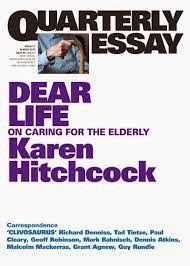
Karen Hitchcock's Quarterly Essay (QE57) Dear Life: On Caring for the Elderly should be a must-read for government, policy makers, medical students and everyone working in the health care profession. It is a compelling and passionate plea to respect our elders, challenge agism, and invest more in quality care.

So often we hear about the tsunami of old age pensioners that will burden an already stretched health care system to breaking point. When the frail and demented find themselves in hospital, specialists race to see who can avoid treating them. They are shoved into corners, over medicated, and encouraged to move on. What is seen is failing kidneys, dodgy hearts, broken bones... Isolated body parts not connected to a real life person. Not a human being; someone's mother; someone's husband; someone who has contributed for their long life to the tax system and now seeks to make a withdrawal. Certainly not someone that you or I will become in twenty or thirty years.

Littered with touching tales of elderly patients, Hitchcock puts a human face to her essay - the man who thought he was a burden, the woman who only wanted time to say goodbye to her family. Woven throughout is the story of the author's Nan, who inspired her to become a GP.

Exposing the sad truth of many end-of-life decisions, the pressure placed on families, the over treatments and rush to deem treatments as futile merely because someone is old, Hitchcock makes a compelling case for reform. Starting with a medical system that shunts people into specialties which creates a false hierarchy within the profession, this allows geriatric care to be devalued reflected in the status and pay of those working in our nursing homes and hospices. If we want quality care in these spaces, we need to train, value and pay the staff that work there and ensure we put enough staff on so that they can spend time with the patients. 

She also argues that the biggest threat to the healthcare system is not the grey army, but rather those of us in younger generations - 'the population of increasingly poor, obese, diabetic, sedentary young and middle-aged who are the multi-morbid patients of the future'.  We need to invest more in attending to risk factors of smoking, alcohol, sodium, obesity, and high blood pressure. Instead, the government has defended the Australian National Preventative Health Agency and cut Medicare Locals. Let's hope the Minister for Health reads this before the exit federal budget and demands investment rather than the inevitable cuts.

Included in this volume is correspondence related to the previous QE on Clive Palmer. Of interest, Richard Denniss writes about the electoral system and the low percentage of eligible voters who actually elected the Abbott government to provide him his supposed mandate.  Dennis Atkins ponders whether the 2015 Queensland state election marks the beginning of the end for Palmer's party, especially with so few Senators remaining.

My reviews of past Quarterly Essays are also on this blog:

Sunday, 29 March 2015

Personal is Political

There is an alternate universe somewhere in which Roxane Gay and I are best friends. We hang out, play Scrabble, watch bad TV and critique popular culture together. We laugh, we cry, we commiserate. We talk about movies, books, music and about race, class and gender. Yeah, I envy the alternate me because she has such a cool friend.

In this universe, I have just finished Dr Gay's collection of essays, Bad Feminist (2014). I was inspired to read this book when I secured tickets to hear her speak at the All About Women festival in Sydney for International Women's Day and had the good fortune of meeting her at the book signing.

Gay describes herself as a Bad Feminist - a tongue-in-cheek term to distance herself from the feminist icons on their pedestals, as well as acknowledging the imperfections of feminism. She writes

"I embrace the label of bad feminist because I am human. I am messy. I’m not trying to be an example. I am not trying to be perfect. I am not trying to say I have all the answers. I am not trying to say I’m right. I am just trying—trying to support what I believe in, trying to do some good in this world..." (p xi)

The essays in Bad Feminist are personal and political - a divide that Gay straddles well, making meaning from the everyday and translating it into the bigger picture.

The first section, "Me", covers aspects of Gay's life from her upbringing in America as the daughter of Haitian immigrants, her first year as a professor, and the cutthroat world of competitive Scrabble.

She then moves on to "Gender and Sexuality" and in a serious of essays she covers a range of topics - domestic violence, body image, sexual identity - linked back to popular culture. She writes about The Hunger Games, Fifty Shades of Grey, Sweet Valley High, Beverly Hills 90210, Girls and much more with an incisive insight. These essays are easy to read, humorous and instantly relatable but at the same time intellectual and thought-provoking.

The section "Race and Entertainment" focusses closely on race issues in Django Unchained, The Help, 12 Years a Slave, and anything by Tyler Perry. These essays were extremely interesting and Gay was very critical of the way in which Hollywood is casually (as well as overtly) racist. Her experience of racism is different than mine, so some of her writing in this section was confronting, making me think deeply. Another challenge in reading this section was that many of the texts and films she was talking about, I have not seen or read, or even heard of.

The final segment on "Politics, Gender and Race" covers reproductive rights, Paula Deen, and much more and serves in many ways as a call to action.

Overall, I really enjoyed Bad Feminist. Gay has given me a lot of food for thought - and a long list of books to read. I like her writing style, and her politics, and I look forward to reading more of her writing. I have her novel  An Untamed State and suspect I will be reading that shortly.


Sunday, 8 March 2015

Make It Happen

To celebrate International Women's Day this year I attended the All About Women festival at the Sydney Opera House with a dear friend.

The theme of IWD this year is 'Make It Happen' which I quite like as a variation of the Picardian 'Make It So'. The question of course is What do we need to make happen? Gender equality? Equal pay for equal work? Reproductive freedom? Equitable representation? Stopping domestic violence? Etc etc. Yes, all of these and more. So days like today serve as a reminder that equality has not yet happened, and that feminists still have a lot of work to do.

There were a lot of sessions to chose from at All About Women, and unfortunately I could not see them all. Here are my highlights:

My day started with a session by Brigid Schulte called 'Overwhelmed: Stop Doing It All". Schulte is a Pulitzer Prize winning journalist and author of Overwhelmed: Work, love and play when no one has the time (2014). She began her research into leisure time when her paper was wondering why female readership had dropped. She asked a time specialist who told her she has 30 hours of leisure time a week - which she found hard to believe as she was juggling a career and family and feeling guilty about competing demands. Schultz was funny and open and offered a lot of insight into neuroscience, cultural norms and how to reclaim a bit of time for ourselves. After the session my friend and I got to chat with her as she signed books for us. It was lovely to meet her and I can't wait to read her book.

Next up was a session called Bad Feminist (2014) with Dr Roxane Gay, author of a collection of essays by the same name. I started reading this delightful book last week in anticipation of hearing her speak. I loved this session, and it was definitely the best of my day at the festival. Gay is a really interesting, straight talking, no BS bad feminist. I really liked the way she answered questions and was unapologetic in her views. For example, she was asked if someone who is pro-life can be a feminist, and Gay said no because that person denies the choice of other women. She also stated that women do not need to hold hands and bring men on the feminist journey - she said they need to figure it out themselves.  Gay has also recently released a novel called An Untamed State (2015) which I look forward to delving into.

My final session of the day was 'Women Warriors' looking at women in the military chaired by Catherine Fox, talking with Major Charmaine Enfield, Commander Cath Hayes, Wing Commander Fleur James, and Alex Shehadie.  Fox is author of Seven Myths about Women and Work and I have heard her speak a number of times at the Festival of Dangerous Ideas and elsewhere. It was great to hear from these amazing women, but somehow this session fell a bit flat for me. I thought there would be more to it - a bit more warrior - but this was lacking. But the women themselves were admirable.

There were of course a lot of sessions I didn't get to that I would have like to. Annabel Crabb spoke about her book The Wife Drought (2014) and I had the good fortune to meet Annabel at the book signing. Australian of the Year Rosie Batty spoke about domestic violence. Helen Garner was on hand to talk about This House of Grief (2014), which I would have liked to have seen given that this book was my favourite non-fiction of 2014, but it conflicted with other parts of the schedule. I also would have liked to hear from Anita Sarkeesian in her presentation called 'Gamergate and Beyond: Women in Popular Culture."

So IWD is over for another year, but I have plenty of books to keep me occupied until the next one!


Saturday, 21 February 2015

You are what you eat

I love food. I think about eating a lot. I try to be conscious of what is in my food and regularly read the labels to contemplate sodium and fat levels, but I get bamboozled by mysterious ingredients. My main concern, as a vegetarian, is that what I eat contains no meat. So I have always considered myself a fairly conscientious eater.

My aunt (who is vegan) encouraged me to read Michael Pollan's The Omnivore's Dilemma (2006) and I have just finished reading this fascinating book.  It has made me look at food in a whole new way. In fact, just this morning, I was at my local farmer's market checking out organic products and contemplating my food choices.


So what is the omnivore's dilemma? Pollan describes it as follows: "It boils down to this: As creatures who can eat many different things, how do we know what's good to eat and what's not?" (p.60) Exactly! How do we know what we are consuming?


The Australian government has recently released a new front of package Health Star Rating system which is designed to help consumers select foods that are better for us. The stars tell is the energy, saturated fat, sugars, sodium and iron content in the food peer 100g allowing us to compare foods as we buy them. I think this is great and it will go a long way towards helping people choose healthier options.


But Pollan takes this a step further and asks us to consider the whole food chain - from farm to table. He does so by telling the story of four meals.

First, he begins with the industrial food chain by taking us to a large corn plantation where corn is mass produced. I had no idea just how much corn is in everything we eat in various forms. "If you count all the corn we eat, directly and indirectly the average American eats a ton of corn every year. We don't recognise it as corn, though, because it's been turned into something else." (p 49)

He then takes us to an industrial organic lettuce plantation, where organic food is mass produced for grocery store chains. I was surprised about some aspects of this type of organic farming, including the allowable pesticides and the fossil fuel usage.

Pollan then moves on to a local organic farm and spends a week with the family, participating in all their activities. This was perhaps my favourite section of the book, as the family lovingly cared for their animals allowing them to live and die with dignity. Here Pollan raises and interesting point about how much we are willing to pay for high quality local food when he points out people grumbling about paying an extra dollar for farm fresh eggs. "Nowadays many Americans are even willing to pay for water - something we can get for free from any tap. So why are we unwilling to pay more for better food."(p123)

The final section sees Pollan trying to cook a meal that he has hunted and gathered himself. This section I probably enjoyed least as the idea of hunting for meat was off-putting (although I do know the delicious sweet taste of fresh chanterelles, having once had them picked fresh in Scotland).

Overall I really enjoyed this book and it has got me thinking more about what I eat, where it came from and how I can make better choices.


Sunday, 15 February 2015

Miss Manners

Hot on the heels of reading Lena Dunham's memoir, I immersed myself in Amy Poehler's Yes Please (2014). It is a light, witty confection of a book, which is pulled together by loose threads and scrapbooked memories.

In some respects it is strange to choose to read a memoir of someone I don't really know that much about. I was not one of Amy Poehler's fans - for whom this book is clearly aimed. While I admired her sketch comedy on Saturday Night Live, I only ever watched that show occasionally and can't really recall any of her characters. I love her award hosting duties with Tina Fey but I would have said I was a Fey-fan. I have not seen Parks and Recreation (...yet) and her other work (Deuce Bigalow, Baby Mama) isn't really my thing. Reading her book, however, I suddenly felt like her biggest fan!

Amy (I can call her that because she feels like a BFF to me now) recalls her childhood in Boston, her early days in improv, the Upright Citizens Brigade, SNL, and the highs and lows along the way. It was instantly relatable to me as I grew up in the same period, not far away, so the pop culture references made me smile knowingly.

I admire the way she wrote about her family, her divorce and the time she apologised for an insensitive comedy sketch. I love her feisty, feminist life lessons, her no bull attitude, and her "good-for-you-not-for-me" approach to life. She is not afraid to share cringeworthy stories about some of her mishaps, and in doing so readers will laugh as they have done them too.

In terms of a memoir, Yes Please is exactly what I thought it would be - a 'how I got here from there' tale with some witty anecdotes and occasional deep-and-meaningful moments. I didn't really need to know Poehler's work in order to read the book, but now that I have read it I am off to binge-watch Parks and Rec!

Sunday, 18 January 2015

Girl, Interrupted

Lena Dunham is an incredibly interesting young woman. The creator of HBO series Girls, I greatly admire Dunham's creativity as a writer and director in crafting a show for and about twenty-something feminist women struggling with life in New York.

She recently published her first memoir - Not that Kind of Girl: A Young Woman Tells You What She Has 'Learned' (2014) - which contains Dunham's reminiscences loosely grouped in sections titled Love & Sex, Body, Friendship, Work, and Big Picture. In a series of essays Dunham explores various vignettes from her life, separated by snappy lists ('15 things I learned from my mother'), in a non-linear, disorderly manner. The book has attracted a fair amount of controversy for some of its contents, and for the multi-million dollar advance given to the author.

Readers wanting to know how a young woman achieved such success as a filmmaker will not find it here. In fact, those seeking to emulate her creative journey will be none the wiser. I was hoping to learn what inspired her and how she has managed her success. Instead I learned too much about Dunham's narcissism and neuroses.

Dunham writes that she lives "in a world that is almost compulsively free of secrets." She puts herself out there - emotionally, physically, artistically - and there is a lot to admire about that. But at the same time I kept wishing that she was more self-protective. Do we need to hear about every sex act she has performed? Does she realise how privileged she sounds? Is she making up these stories anyway?

There is humour here and there (not dissimilar to Girls in that respect) and there are moments of depth and insight. But largely I felt disappointed by Not That Kind Of Girl because it was Not That Kind of Memoir. Perhaps that was my problem - hoping it would be something it wasn't.

Tuesday, 13 January 2015

Arsenic and Old Lace

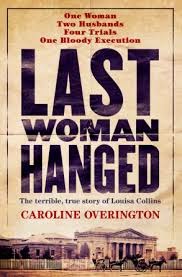
Last Woman Hanged (2014) by Caroline Overington tells the true tale of Louisa Collins, convicted murderer who was executed in Sydney in 1889. Found guilty of poisoning her second husband Michael Collins with arsenic, Louisa was hanged, leaving her young children in the care of the State.

Louisa was born in Belltrees near Scone, NSW and was married at nineteen to local butcher Charles Andrews. She spent much of the next twenty years pregnant with the nine children she would bear. Possibly ill-matched, Andrews was a committed family man who adored his wife, while Louisa perhaps missed out on many experiences that she would have enjoyed in lieu of domesticity.

When the couple moved to Botany in 1886 so that Andrews could work as a wool-washer, they took in boarders to make ends meet. Rumours circulated in the tight Botany community that Louisa enjoyed drinking with the men who stayed in their home.

In early 1887 Andrews took ill and after a few days of excruciating pain he died. Louisa's behaviour immediately after his death was viewed unfavourably by police and local gossips, especially as she did not don mourning clothes and applied for access to Andrews life insurance. Within two months of being widowed, Louisa married Michael Collins, a former boarder, pregnant with his child.

Collins was not good with money and the insurance funds dissipated quickly. Their infant son John died, and Louisa's older children were not fond of their new stepfather. In mid-1888 Collins took ill, with symptoms similar to Andrews, and died on 8 July. Almost immediately Louisa was arrested for his murder by poisoning.

What happened next was appalling. Louisa Collins was tried - four times - by a prosecution determined to convict. The evidence against her was entirely circumstantial and there was much to suggest that both men may have became poisoned through their work as wool washers as skins were treated with arsenic. She had an extremely ineffective defence attorney and her young daughter May was compelled to give evidence against her. The first three trials resulted a hung jury, but the last, with a backdrop of media frenzy, voted to convict. These four trials occurred in rapid succession with gross misconduct on the part of many of the judges.

Overington combs through the evidence for and against Louisa and highlights many inconsistencies which lead the first three juries to be unconvinced of her guilt beyond reasonable doubt. She also explored the historical context of the rise of the women's suffrage campaign, the temperance movement and the sensationalism of the media. What emerges is a travesty of justice in which a woman was killed by the State in a most horrific way.

This book was intriguing in many respects with Overington's skills as a journalist lending weight to her research. I particularly enjoyed the story of the early feminism in Australia. I learned a great deal about how autopsies were performed in hotels, the travel by tram around Sydney, and about the medical fraternity of the time. Although I need no further evidence to support my stance against capital punishment, this book was a reminder of how State-sanctioned killing is immoral and unjust.

I did not particularly like Overington's writing style, however, and felt that some of her turns of phrase distanced me from the content. She included many asides where she presented information with a modern gaze, and would have been better off sticking purely to the facts. An example is when she was talking about Alexander Green, one of the first hangmen in NSW. Overington writes "like most normal people, Green did not set out to become a hangman...". This sentence jarred me as judgemental and unnecessary. Later she writes about Louisa's fate moving to Parliament house "... in about the time it took to traverse the distance by foot. Well, not quite, but the point is made." The point could have been made without the poor analogy. This occurred regularly throughout the book and I wished it had been better edited prior to publication to remove some of these clunky asides.

But overall I am pleased that I read the book and had a glimpse of this time in our history. This book is recommended to those with an interest in history or the judicial system.

Sunday, 4 January 2015

Larger than Life

The latest Quarterly Essay (QE56) by Guy Rundle is Clivosaurus: The Politics of Clive Palmer (November 2014). An intriguing tale of a politician and a flawed political system, Rundle has written a witty, pithy account of Palmer's political rise and what he may mean for Australia and our political system.

In 2013 Clive Palmer - Queenslander, self-proclaimed billionaire, mining magnate, dinosaur enthusiast and Titanic-fan - formed his own political party and sought appointment as the member for Fairfax in the federal election. The Palmer United Party (PUP) was initially dismissed by the media and the mainstream parties as a sideshow without any chance of winning, but surprised many by securing one seat in the House of Representatives and two in the Senate. Canberra hasn't been the same since...

A larger-than-life figure, Palmer has always seemed to me to be a bit of an eccentric, bumbling clown - thumbs-upping in photo shoots, making up policy as he goes along and generating publicity stunts. Whether it is through his twerking on TV, storming out of interviews, or his policy flip-flops, I could never seem to get a handle on who Clive Palmer is, and what he hopes to achieve. I cynically presumed he took to politics to further his own ego and to serve his own ends (like reducing taxes on mining companies). In this essay, Rundle attempts to get to the heart of the mystery - who is Clive Palmer?

Along the way we learn about Palmer's upbringing, his business ventures and his poetry (Rundle drew heavily from Sean Parnell's Clive - The Story of Clive Palmer (2013) to flesh out Palmer's backstory). This was extremely interesting and presented Palmer as a much more complex character than I had given him credit for. While Palmer's philosophy and politics do not align with mine, and I am still very sceptical about his motives, I can no longer write him off as merely a media-hungry buffoon.

Rundle's essay also exposes the flaws of the Australian political system - which is marred by loop-holes and complexities. The number of fringe candidates, satirical parties, and outright odd-balls that make it on to the ballot (and worse still into Parliament) is evidence of a system that needs review. The system can be gamed, with 'preference-whisperers' and backroom deals, resulting in the election of people with very low primary votes. But this is not new, rather it is a known problem that no one seems willing to tackle.

Illuminating the 'triple lock' of the Australian system - compulsory voting, preferential voting and taxpayer campaign funding - Rundle shines a light on areas that need to be urgently addressed. He calls for an open discussion about creating a more democratic system and lists items for inclusion in this debate (voluntary voting, multi-member electorates, optional preferences, campaign spending, role of the governor general). I whole heartedly agree.

Clivosaurus was another excellent essay in this series. My reviews of past Quarterly Essays are also on this blog:

Thursday, 1 January 2015

Planning for 2015

It is never wise to plan my reading for the year. As soon as I decide what I am going to read, I get distracted by new novels and non-fiction that is published throughout the year and by books I find lurking on my shelves waiting for their time to be read.

But I do have a overall plans to try and read at least two books a month (so 24 for the year). I would like to try and vary my reading some more and tackle some of the books I have recently been given.

Biographies are always enjoyable. I like hearing of how other people have lived and the challenges they have overcome. The biographies I have on my to-be-read pile include:

I guess that list says something about my admiration of strong, brave, funny, feminist women. However, I may throw in a volume by Stephen Fry along the way.

In addition to biographies, my keen interest (as always) is political economy - with special attention to social policy, wealth inequality, and gender issues. On my list for 2015 are:
  • A Bigger Prize (2014) by Margaret Heffernan
  • Slavery Inc - The Untold Story of International Child Sex Trafficking  (2010) by Lydia Cacho 
  • The Omnivore's Dilemma (2006) by Michael Pollan (Update: read February 2015)
  • Capital in the Twenty-First Century (2013) by Thomas Piketty
  • Quarterly Essay 56 - Clivosaurus (2014) by Guy Rundle  (Update: read January 2015)
  • Quarterly Essay 55 - A Rightful Place (2014) by Noel Pearson
  • Quarterly Essay 54 - Dragon's Tail: The Lucky Country After the China Boom (2014) by Andrew Charlton
I will have another year's worth of Quarterly Essay arriving and other non-fiction to add to this list as I go along.

In terms of fiction, my to-be-read pile changes regularly as I am often taken by a theme or an author or dip back in to re-read an old favourite (such as my annual Harry Potter spree!). On the list are:


  • The Paying Guests (2014) by Sarah Waters
  • All the Birds, Singing (2013) by Evie Wyld
  • Nora Webster (2014) by Colm Toibin
  • Top Secret Twenty-One (2014) by Janet Evanovich 
  • A Feast for Crows (2005) by George R R Martin - fourth instalment of Song of Ice and Fire series.
  • World of Wonders (1975) by Robertson Davies - final instalment of the Deptford Trilogy which is a long overdue read.

  • Add to this list some of the new books expected from Kazuo Ishiguro (The Buried Giant), Anne Tyler (A Spool of Blue Thread), Irvine Welsh (A Decent Ride), and hopefully a new Robert Galbraith.

    So overall it looks like a great year for reading. Can't wait!

    Wednesday, 31 December 2014

    My 2014 in books

    I have enjoyed my reading in 2014, and again tried to balance my fiction and non-fiction reads as well as taking on new authors that I have not read before. I had hoped that the year would be a better one for reading and blogging, and overall I think it has been.

    In January I wrote that my priority was  to finish books that I had already started, which included:

      • Oryx and Crake (2003) by Margaret Atwood (Update - Read Jan 2014
      • Mortality (2012) by Christopher Hitchens (Update - Read Feb 2014)
      • The Cuckoo's Calling (2013) by Robert Galbraith (JK Rowling) (Update - Read Sept 2014)
      • A Sport and a Pastime (1967) by James Salter
      • World of Wonders (1975) by Robertson Davies
      • A Feast for Crows (2005) by George RR Martin
      • Wolf Hall (2009) by Hilary Mantel
      • And the Mountains Echoed (2013) by Khaled Hosseini
      • The Getting of Wisdom (1910) by Henry Handel Richardson
      • The Slap (2008) by Christos Tsiolkas

      I managed to only finish three of those books (Atwood, Hitchens and Galbraith) as I was tempted away by others. While I started and stopped all of the others, they did not hold my interest at the time but may be revisited again in the future.

      Instead, I read the following in 2014, in addition to those listed above:

      In terms of fiction, it seems as though I read a few books on dysfunctional families, including those by Tartt, Tyler, Steadman and Sedaris. Each different in their own ways, but all demonstrating how families can move from places of love and security to fear and loathing. Of these books, Tyler's Dinner at the Homesick Restaurant was the stand-out for me - beautifully written, well crafted story. 

      While I continued to read Evanovich's Stephanie Plum series, I have been keen to find another series to sink my teeth into. JK Rowling's move into crime novels has been most welcome. I loved her writing as Robert Galbraith and consumed both The Cuckoo's Calling and The Silkworm in rapid succession.  I look forward to reading more of this series once Rowling has a chance to put pen to paper. 


      In terms of non-fiction, Kajsa Ekis Ekman's book on prostitution and surrogacy was an eye-opener and I was keen to read this after having heard her speak at the Festival of Dangerous Ideas.  I have also greatly enjoyed reading the Quarterly Essay this year and have written blog entries about two of the titles I have read:
      In addition, I  reviewed the Sydney Theatre Company production of Macbeth which I attended in September 2014.

      My 2014 highlights were two books by Australian authors.

      Richard Flanagan's Booker prize winning The Narrow Road to the Deep North was a stunning read and one I have thought about almost daily since finishing. I was so deeply touched by this story of love and war.

      Helen Garner's non-fiction account of a murder trial, This House of Grief, was also a compelling read. The story of how Robert Farquharson was tried for drowning his three sons in a dam in rural Victoria was heartbreakingly brilliant.

      Overall, I had a good year for reading and I have a number of books to tackle in 2015...

      Monday, 29 December 2014

      Father's Day

      On Father's Day in September 2005, a man was driving his three sons through rural Victoria to his former marital home. His car veered off the road, through a fence and into a deep dam. The man escaped, but Jai (8), Tyler (6) and Bailey (2) drowned in the murky dark waters.

      Over the next eight years Australian author Helen Garner would sit through two murder trials which would ultimately find the man, Robert Farquharson, guilt of murder and sentenced to three life sentences - a minimum of 33 years imprisonment. Garner's experience is documented in This House of Grief (2014), a gripping true crime account in which she empathises with everyone involved in this tragedy. 

      Farquharson, claimed he was struck by a sudden coughing fit and blacked out at the wheel, awakening once the car was plunging to the bottom of the dam. In contrast the prosecution presents a premeditated crime to get back at his ex-wife for leaving him.

      Garner describes Farquharson as a bumbling, coddled, man-child, who clearly loved his kids but was at a loss when his wife left him. His ex-wife Cindy Gambino stood by him during his first trial, protesting that this was a horrible accident. By the retrial,  her perspective changes and Gambino comes to a view him as a vindictive, embittered man, determined to take away the only thing that really mattered to her.

      An incredible observer, Garner picks up the minute details of the case. From the fatigue of the jurors, the resolve of Gambino's parents and the resilience of barristers on both sides, Garner documents this first person account of how the murder trials unfolded. She describes how the trial seeped into her daily life and caught her unawares at the greengrocers, when holding her grandson, at the coffee cart outside the courts, and in after court drinks with colleagues.

      I am generally not a fan of true crime books, as they often tend to glorify and revel in the gory details. But Garner is a masterful writer with a keen bullshit detector who is able to create a compelling story of the human side of this tragedy. She wrestles with the case as the jury might and continually looks for the doubt in the evidence presented. The duelling experts, the tedium of the technical details of tyre tracks and car speeds, the guilt felt by family friends, the description of expected behaviour for those affected by trauma. Above all, she presents a compelling case for the rule of law - a story that resonated with me and recalled my law school days pouring over case notes and observing in court rooms.

      I am a huge admirer of Garner's work - in fact her Joe Cinque's Consolation (2004) about a Canberra murder trial is one of the most amazing books about the law that I have ever read. She did not disappoint with her account of the Farquharson case, which I consumed in a mere three days after receiving it for Christmas. At the end of the book we are left with a reminder that three young lives have been lost, two families have been shattered, and a comity has been torn apart.  All of us, however removed from this tragedy, are touched by this terrible loss and grieve in our own ways.

      Monday, 15 December 2014

      Family Ties

      In 2004 David Sedaris published his collection of semi-autobiographical short stories, Dress Your Family in Corduroy and Denim. As he depicts vignettes from his childhood in North Carolina, through to his adult life in New York and Europe, Sedaris shines a spotlight on his family and highlights the absurdity of so many family interactions.

      Funny, touching, bizarre and bitchy, Sedaris doesn't hold back in depicting his parents, siblings and partner. Whether describing his boofhead brother's wedding in 'Rooster at the Hitchin Post', or the hoarding of one of his sisters in 'Put a Lid on it', Sedaris is brutal. Whether he is brutally honest is another matter - I suspect there is more than a little bit of artistic licence taken.

      There are plenty of touching moments too - particularly in relation to his homosexuality. Clearly his father had difficulty accepting his eldest son, kicking him out of the house. His brother routinely calls him names. He is inundated by hate when listening to talk back radio. Among the name calling and shame, life lessons emerge. He peppers his tales with truisms such as 'Boys who spent their weekends making banana nut muffins did not, as a rule, excel in the art of hand-to-hand combat.'

      Perhaps what makes Sedaris interesting is that he is such an unlikely character himself. Neurotic, obsessive-compulsive, unsympathetic, Sedaris is a wonderful humourist who makes readers uncomfortable when describing his own discomfort.

      I have previously reviewed Sedaris' Squirrel Seeks Chipmunk: A Wicked Bestiary on this blog.

      Saturday, 6 December 2014

      Casualties of War

      I have just finished Richard Flanagan's The Narrow Road to the Deep North (2013) and am absolutely in awe of this magnificent novel and want to share it with everyone I know. A worthy winner of the 2014 Man Booker Prize, Flanagan has created a compelling story of love, mateship and war.

      Dorrigo Evans is a young Australian doctor who heads off to war. Before he departs for the front, he meets and falls in love with Amy - the young wife of his uncle Keith. He travels to Europe and then Asia, ending up a prisoner of war on the Thai-Burma Railway, and all the while he dreams of a life with his beloved.

      Because he is a surgeon, Dorrigo's job is to care for the men and ensure they are fit enough to work the line. Each day he counts out  hundreds of men, from an ever diminishing pool, fit enough to haul timbers, break rocks, and clear the dense jungle for the ill-fated railway. Suffering from starvation, ulcers, lice, cholera, beri-beri, malaria and broken limbs - those who can stand must work. Dorrigo knows that he is sending many to their deaths and he performs a delicate dance with his captors to negotiate on the men who will serve.

      In the camps we hear about Rooster McNeice, Jimmy Bigelow, Darky Gardiner, Bonox Baker, Sheaphead Morton, Tiny Middleton, Gallipoli Von Kessler and others - and witness Australian mateship in its truest form. Tiny acts of defiance, kindness and love sharply contrast with the barbarity and horror of the war. Those who returned were never the same - suffering trauma that impacted their lives, livelihoods and the people who loved them. We also learn the fate of Colonel Kota, Major Nakamura, and other Japanese and Korean prison guards and get some insight into their views of the railway: their commitment to serving the Emperor, their sense of honour and their post-war reflections.

      Told in a non-chronological order - the book jumps back and forth between the pre-war days, the POW period and the aftermath of war with the war crimes trials and Dorrigo's unwanted fame. The novel is littered with haiku from poets Issa, Buson and Basho - the latter providing the book's title. The simplicity and beauty of these brief verses are juxtaposed with the brutality of war and provide a glimmer of hope.

      My heart broke many times during this story - with the tale of Darky Gardiner, Ella's unrequited love, the Tasmanian bushfire, the letter that changed fates and many other moments on the line. It is not an easy read but it is compelling.

      Flanagan dedicated the novel to his father, who was POW on the railway. While this is not the story of Flanagan senior, it was certainly inspired by him and also by Edward 'Weary' Dunlop, an Australian hero of the camps. I learned a lot about the death railway through this book and it inspired me to seek out more information. Over 60,000 POWs from Britain, Australia, America, Holland and elsewhere worked on the railway and around 16,000 died from the physical labour, disease, starvation, and beatings while working the line.

      I have read many of Flanagan's previous novels - including The Sound of One Hand Clapping (1997), The Unknown Terrorist (2006) - and have consistently been impressed by his abilities to create full characters and reflect the beauty of the Australian landscape. In this novel, Flanagan's prose creates a vivid portrait of love and war. I am so pleased the Booker was awarded for this novel.

      Shortly after completing this book I watched the film of The Railway Man (2013) based on the life of British engineer Eric Lomax. He was imprisoned in the death railway camps in 1942 and tortured for building a radio. He returned home a broken man and in old age sought out one of his captors. Starring Colin Firth and Nicole Kidman, it was a good film with solid performances. However, I felt that it didn't give the depth of experience and appreciation of the trauma that Flanagan's novel provided.

      Saturday, 8 November 2014

      Mightier than the Sword

      Immediately upon finishing The Cuckoo's Calling, I found myself immersed in the next Cormoran Strike adventure. The Silkworm (2014) commences a few months after Strike has been lauded for solving the murder of Lula Landry. Business is booming with various clients seeking evidence to catch out their unfaithful partners.

      One day a mousy woman named Leonora Quine asks Strike for assistance in locating her missing husband, novelist Owen Quine. Strangely taken by this woman's lack of pretence and her need to care for a disabled child, Strike agrees, despite dubious assurances of remuneration. Soon Strike and his trusty sidekick Robin are off to solve the mystery of Quine's disappearance.

      JK Rowling, writing as Robert Galbraith, must have enjoyed herself writing this novel. Set inside London's incestuous publishing industry, the tale features plenty of literary allusions and cattiness among the publicists, agents and editors, not to mention the literati. The novel within a novel works well as we learn more about Quine's latest novel, Bombyx Mori, and the circumstances surrounding his disappearance.

      This is a thoroughly enjoyable mystery that unpeels and reveals itself slowly. I enjoyed learning more about Strike, and it was great to see Robyn evolve and become a more active player in the detective business. 

      While The Silkworm can be read as a standalone novel, I would recommend starting the series at the beginning. I understand Rowling is at work on the sequel and I look forward to seeing what happens to Strike and Robin next.

      My review of The Cuckoo's Calling is also available on this blog.