Saturday, 23 July 2022

Blue Moon

I have written before about how much I enjoy Australian crime thrillers. I have long been a fan of Jane Harper, Chris Hammer, Sarah Bailey and have recently become acquainted with Garry Disher. So whenever I hear about a new voice in Australian noir, I jump at the chance to find a new thriller I can sink my teeth into.

In May 2022 journalist Matthew Spencer published his debut novel, Black River. Set in Sydney at the peak of summer, there is a serial killer on the loose which has the whole city on edge. The 'Blue Moon Killer' has murdered two people already in Gladeseville, a suburb on the north side of the Parramatta River. When a body of a teenage girl is found at an elite boys school in North Parramatta, more than 10km up river, there are enough similarities to concern police that they will have to cast a wider net. 

Adam Bowman is a journalist working the late night shift at a national paper owned by a media baron. He goes out to cover the case and has an advantage as he grew up at this elite school where his father was a teacher. He knows the shortcuts and secret entries, so can make his way into the sprawling campus with ease. 

Detective Sergeant Rose Riley is a driven investigator determined to crack the case. Working as part of an investigative team Riley recruits Bowman to assist with well timed leaks and exclusives. The relationship between the two is symbiotic, but not wholly trusting, and I was pleased that there wasn't a romance whacked into this storyline. 

The characters are well crafted with sufficient information to make them realistic, and enough backstory yet to be revealed should this novel end up becoming the first in a series.  I really liked how Spencer portrayed the state of journalism - with Bowman working at an office which has been gutted by cutbacks, an absentee media owner who calls the shots, and the pressure to break stories with a blistering headline and exclusive access.

The story was complex enough to keep the reader guessing, with a lot of characters to keep track of. The page-turning pace builds to an exciting and satisfying conclusion. Spencer has an intriguing writing style, in which he uses Aussie slang and brand names, some of which may be problematic for an overseas market. But personally I loved it. Having made Sydney my home for the past 25 years, I appreciated the Spencer wove in aspects of the city from Surry Hills to Balmain to Parramatta. After so many Aussie crime novels set in fictional outback towns, it was great to have one set here in the Harbour City. 

Overall, an excellent debut novel and a wonderful new voice in Australian crime thrillers. 


Thursday, 21 July 2022

Booker 2022 Predictions

The Booker Prize Longlist will be announced next week. It is always difficult to predict which novels will make the cut. Sometimes there will be obvious contenders, but the Booker always throws in some surprises. 

To be eligible, the novel has to have been written in English and published in UK/Ireland between 1 October 2021 and 30 September 2022. While I am not across when novels were published in UK/Ireland, I am going to take a guess at who might appear on the longlist.

My predictions are:


I would love it if Jennifer Down were nominated for her award winning novel Bodies of Light, or Jennifer Egan for The Candy House, but I am not sure if they meet the eligibility rules.  

The longlist will be announced on 26 July, followed by the shortlist on 6 September and the winner announcement in October. 

Wednesday, 20 July 2022

Miles Franklin Award Winner 2022

The winner of the 2022 Miles Franklin Literary Award, Australia's most prestigious literary award, was announced via a live online presentation on 20 July 2022. This year the award and its $60,000 prize went to Jennifer Down for her novel, Bodies of Light.

Maggie Sullivan is institutionalised, growing up in a foster homes and group facilities after her father is jailed. Neglected and abused, by 19 she is diagnosed with depression and trauma. The novel follows Maggie into adulthood, when she is forced to encounter her long buried past. 

I heard Jennifer Down speak at the Sydney Writers Festival in May and found her extremely impressive. Bodies of Light was also shortlisted for the Stella Prize. I am so pleased that she won and that her work will receive a higher profile. 

The judges said "Bodies of Light invites readers to witness the all-too-often concealed, destructive forces of institutionalised care. With extraordinary skill and compassion, Down has written an important book which speaks to an urgent issue in contemporary Australian life.”

Jennifer Down said “It’s a profound honour to be awarded the Miles Franklin Literary Award—I’m still pinching myself. To be longlisted, and then shortlisted, among authors whose works I’ve long read and admired, already felt like a stroke of exceptional fortune. I was, and am, elated to be in the company of writers embracing stylistic, thematic and formal diversity, whose works explore such different slivers of ‘Australian life’.”


The announcement of the winner was live streamed:


Saturday, 16 July 2022

Sisters of Crete

In the past few years I have become fascinated with novels that retell Greek myths from the perspective of women. Madeline Miller's Circe is perhaps the best example, taking a fairly minor character from Homer's Odyssey and putting her centre stage. Pat Barker's delicious trilogy about Troy is narrated by Briseis, Achilles' slave. Natalie Haynes, Margaret Atwood and other authors have retold these myths for a contemporary audience.

I am not entirely sure why I love these novels so much. Perhaps it is because the authors take a familiar story and tell it through a female lens. Perhaps it is because the novels breath new life into classic tales. Regardless, I anticipate my obsession will continue and I am currently planning a trip to Greece where I can walk in the mythical footsteps of these wonderful characters. 

My most recent adventure is with Jennifer Saint's debut novel, Ariadne (2021). The story of Ariadne is well known, but for those unfamiliar the next paragraph contains spoilers. 

The daughter of King Minos of Crete and his wife Pasiphae, Ariadne and her sister Phaedra grew up in a palace. Their half-brother was the Minotaur - a half-man, half-bull beast - who resided in a complex labyrinth under the palace. Each year the seven young men and women were sent from Athens to be sacrificed to the Minotaur, as Minos' price for the killing of his son. One year, Theseus, son of Aegeus, King of Athens, is among those to be sacrificed. He slays the minotaur and takes Ariadne with him to Naxos. On Naxos, Ariadne meets the god of wine, Dionysus, whom she eventually marries. The tale, of course, ends in tragedy with Ariadne meeting her fate at the hands of Perseus, slayer of Medusa. 

Jennifer Saint tells the story of Ariadne's life with the first third concentrated on her time at Crete, the next third on Naxos, and the final part wraps up the tale. In telling this story, Saint was able to bring in many different myths - Icarus, Medusa, Semele, Daedalus, Acoetes, and more. While this was enjoyable, I can't help but think that some of these side-stories could have been left out to allow more time for Phaedra's story and to flesh out the characters. 

As a protagonist, Ariadne was passive and frustrating. She was a compliant daughter destined to become a compliant wife. Ariadne makes a significant decision early on which sets the story in motion. But just when you think she will be the hero of her own story, she reverts to be passive and compliant again. She spends a lot of time walking around her vineyards, turning a blind eye to what might be happening around her. Her sister Phaedra is far more interesting. A curious, adventurous child, Phaedra ends up in Athens, forced into a role she does not want. The chapters then alternate between Ariadne and Phaedra, which enliven the story and I found myself wanting more Phaedra.  But as the novel heads towards its conclusion, when both women take their fates into their own hands, the ending is hurried and unsatisfying.  

Despite my reservations about Saint's passive characterisation of Ariadne, the pacing which felt rushed at the end, and some jarring language choices, overall I enjoyed this debut novel. Saint's second novel, Elektra (2022), is already on my bookshelf. 

Tuesday, 28 June 2022

London Calling

It's 1947 and Billie Walker's private inquiry building is bustling. After the high profile case covered in The War Widow (2019) - Tara Moss' first Billie Walker mystery - Walker has become well known in Sydney and has seen a rise in clients. Much of her work involves helping people secure grounds for divorce, by procuring evidence of infidelity. She and her trusty assistant Samuel Baker tail men through the seedy underbelly of Kings Cross to take photographs of liaisons. It is not her preferred kind of investigation, but it pays the bills.

A new client arrives with a tantalising offer. Vera Montgomery's husband is missing, last seen in Paris two years earlier. Mrs Montgomery cannot move on her life unless she can secure a divorce or proof of death. Would Billie travel to Europe to find out what happened to him? 

Billie has many memories of Paris from her time as a war correspondent. It was where she first met her photojournalist husband Jack, who went missing during the Warsaw Uprising in 1944. With an all-expense paid trip to London and Paris, Walker may also have an opportunity to investigate more than one disappearance. But first, she and Sam have to deal with whoever is following them...

The Ghosts of Paris (2022) is a thrilling follow up to The War Widow (2019). Moss' knows how to write a gripping page-turner, with enough action and plot twists to keep the reader guessing. Packed with historical detail, we are transported to another time and place. Taking the action to Europe allows Moss to explore the post-war recovery and the societal differences with Australia. I love Moss' characterisation of Billie - a quick-witted, independent woman in a man's world. Billie is an intelligent, empathetic and well-rounded heroine. 

While we may need to wait for the next Billie Walker novel, Moss has recently confirmed a two-book deal with Harper Collins Australia to expand the series. I can't wait to see what Billie gets up to next and to spend more time in her world. Until then, we'll always have Paris.

Friday, 24 June 2022

Miles Franklin Shortlist 2022

 The 2022 Miles Franklin Award shortlist was announced this week, made up of the following works:

  • Michal Mohammed Ahmed - The Other Half of You
  • Michelle de Krester - Scary Monsters 
  • Jennifer Down - Bodies of Light
  • Alice Pung - One Hundred Days
  • Michael Winkler - Grimmish

Richard Neville, Chair of the judging panel, said of the shortlist:
 “The outstanding feature of this year's Miles Franklin shortlist is the range of dynamic and diverse voices that address the experience of pain, intergenerational trauma and intergenerational dialogue with compassion, exceptional craft and rigorous unsentimentality."


There hasn't been much time between longlist and shortlist so I have not read any of these titles.  I did attempt to read the longlisted Grimmish, which I found interesting though difficult to enjoy. Unfortunately had to return it to the library unfinished as I ran out of time so not sure if I will complete that. 

When I predicted which titles would make the cut, I had expected Larissa Behrent, Jennifer Down, Michelle de Krester, John Hughes, Claire Thomas and Christos Tsiolkas to make the shortlist - so I only guessed right on two of the titles. I had not predicted the controversy surrounding novelist John Hughes and allegations of plagiarism, which saw his novel pulled from eligibility.

Having seen Jennifer Down at the Sydney Writers Festival talk about her novel Bodies of Light, I am going to root for this to win. But I also like the idea of Grimmish taking out the prize for its unique form and creativity. 

The Winner of the $60,000 prize will be revealed on 20 July 2022.

Thursday, 16 June 2022

Women's Prize for Fiction Winner 2022

The winner of the 2022 Women's Prize for fiction has just been announced. Ruth Ozeki won for her novel, The Book of Form and Emptiness.

Chair of Judges Mary Anne Sieghart announced the winner, stating:

“In an extraordinary year for fiction written by women, and from an incredibly strong shortlist, we were thrilled to choose Ruth Ozeki's The Book of Form and Emptiness, which stood out for its sparking writing, warmth, intelligence, humour and poignancy. A celebration of the power of books and reading, it tackles big issues of life and death, and is a complete joy to  read. Ruth Ozeki is a truly original and masterful storyteller.”

The Book of Form and Emptiness is the story of 14 year old Benny Oh who hears voices after his father dies. When his mother becomes a hoarder, the objects in his house speak louder, so Benny seeks respite in the local library.

Ruth Ozeki received the £30,000 prize and the award ‘Bessie’, a limited-edition bronze figurine. American-Canadian author and film-maker Ozeki is probably best known for her novel A Tale for the Time Being (2013) which was shortlisted for the Booker Prize.

I have not yet read this novel. I had been hoping that Meg Mason would win for her wonderful Sorrow and Bliss, or Maggie Shipstead for her epic Great Circle. However I will now move Ozeki up my reading list.

Saturday, 11 June 2022

Patron Saint

In 2020 Douglas Stuart shot to fame with his debut novel Shuggie Bain (2020), winner of the Booker Prize. Many authors struggle to write their second novel, and the stakes were particularly high for Stuart following the critical and commercial success of Shuggie Bain, which has sold over a million copies. His second novel, Young Mungo (2022), was released earlier this year and I am so pleased that Stuart has crafted a brilliant, engrossing novel with heartbreaking, memorable characters.

Shuggie Bain told the story of an alcoholic single mother trying to raise her family in 1980s Glasgow. While her older children leave the home, her youngest son Shuggie stays. Young Mungo follows a familiar path, featuring a similar family in 1990s Glasgow, but instead the focus is on the teenage son. 

Mungo Hamilton is a fifteen year old boy with a kind heart. He never knew his father but is deeply devoted to his mother Maureen, called Mo-Maw. Unfortunately Mo-Maw is not maternal, resenting that she has wasted her best years on her three weans. She routinely drinks herself into a state where she disappears for days on end, shacking up with some man, and then returning to wreck havoc on the family. Mungo's closest ally is his clever older sister Jodie. She has effectively raised Mungo and is desperate to escape this life by going to university and make something of herself. 

The poor family live in a housing commission scheme in which there is sectarian violence between Protestants and Catholics. The Hamiltons are Protestant and Hamish's older brother Hamish (or Ha-Ha) is a wee gangster - a hard man leading a youth gang to steal, fight and run from the polis. Hamish terrorises everyone around him and he seeks to recruit sensitive Mungo and toughen him up, to bolster Ha-Ha's reputation and his gang numbers.

From the outset we know that something bad is going to happen in this family. We first meet Mungo as he is being shipped off by his mother on a camping trip with two older men - Gallowgate and 'Saint' Christopher - presumably hoping they will teach him some life skills and be a father figure to the boy. The novel shifts back and forth from Mungo's life in Glasgow and what transpires on this trip. Overtime we learn more about these two men, how Mungo ended up with them, and how Mungo is changed as a result of this experience. These chapters are tense and dark - a deep foreboding creeps over the reader each time we are taken from Glasgow to the loch. While life in Glasgow is also hard, at least we know that Mungo is safer here than in isolation at the campsite. 

Some months before the camping trip, Mungo befriended sixteen year old James Jameson, a Catholic boy who also lives in the tenements. His mother has died and his father is largely absent, working on an offshore rig. James takes comfort in his pigeons, spending most of his time in his doocot nurturing these birds. The boys become friends and over time they realise the extent of their feelings for one another. But it is not safe in this place or at this time to be gay. Mungo and James have to hide their love, plus with the sectarian violence all around them, these star-crossed lovers should not even be friends. They make plans to run away together as soon as Mungo turns sixteen. 

Stuart covers complex themes, writing about toxic masculinity, sexuality, violence, addiction, poverty, politics in a confronting but compelling way. The blossoming romance is told with such empathy and in severe contrast to the brutal violence elsewhere in the novel. Some readers may be put off by the subject matter, but I would encourage people to persevere. I absolutely loved Young Mungo and to enhance my experience of the novel, I read while listening to the audiobook narrated by Scottish actor Chris Reilly. 

Special thanks to my mum who gave me Young Mungo. I really enjoyed this story and these wonderfully written characters will stay with me for a very long time. 

Sunday, 5 June 2022

Hell to Pay

I am a huge fan of crime novels set in small towns across Australia, quickly inhaling each new novel by Jane Harper, Chris Hammer, Sarah Bailey and others. But somehow I overlooked Garry Disher, an award-winning writer of several series of crime books including the Wyatt novels, the Challis and Destry novels and the Paul Hirschhausen series. A few weeks ago at the Sydney Writers Festival, I attended a session called 'Small Towns, Big Secrets' where Disher was one of the panelists talking about crime novels. Intrigued by his commentary, I started the Hirschhausen series.

Bitter Wash Road (2013) is set in South Australia in the fictional town of Tiverton. Paul Hirschhausen has been assigned to man the single-officer police station in the town. 'Hirsch' was previously based in Adelaide as a detective, but has been demoted on account of his role as a whistleblower against corrupt colleagues. As such he is known as a rat, and his fellow officers want little to do with him. When a pistol cartridge shows up in his mailbox, he knows his reputation has followed him and he is not wanted in this town.

Hirsch's boss is Sergeant Klopp, based at Redruth, some 40km away. Klopp has no time for cops who turn on cops, and turns a blind eye to the criminal actions of his own officers Nicholson and Andrewartha. Hirsch is on high alert whenever he interacts with these officers.

When the body of a sixteen year old girl is found on the side of the road, Hirsch sets out to investigate what happened, not convinced it was a simple hit-and-run. He soon finds obstacles thrown in his path by everyone around him. He is warned off pursuing the matter, but Hirsch persists and soon there are other deaths to investigate which at first appear unlinked but may lead to something more sinister happening in Tiverton and the surrounding area. 

Hirsch is an interesting character - he's a decent cop, with a strong ethical core and a desire to do well in his job. He gets called out on random jobs in this small town - when gunshots are reported on Bitter Wash Road, for drunk and disorderly conduct, for shoplifting and the like. The colourful locals are well drawn too, painting a picture of a hard life in this desolate place. 

I really enjoyed this novel. I found Disher's writing style to be intelligent and intriguing. He is concise, yet descriptive, giving the reader a really strong sense of place with the way he depicted the landscape and environment.  Disher is an excellent writer, moving the story along by creating tension and pace. 

I am so pleased to have discovered him and delighted to know that he has dozens of novels to discover. I look forward to reading the next two books in the Hirsch series - Peace (2019) and Consolation (2020) - but I am also keen to read The Way It Is Now (2021) Disher's latest standalone novel.

Note: When Bitter Wash Road was published in America in 2014, it was published as Hell to Pay.

Monday, 30 May 2022

A Beautiful Mind

Working my way through the 2022 Women's Prize shortlist, I spent a wonderful day reading Meg Mason's novel Sorrow and Bliss (2020). 

Shortly after her 40th birthday, Martha and her husband Patrick separate. Now alone, Martha reflects on her life trying to figure out what happened. Patrick has been part of her family for as long as she can remember, since attending her aunt's annual Christmas lunches while visiting from boarding school. She cannot imagine life without him. 

With her sister Ingrid, Martha grew up in an eccentric family of creatives. Her mother repurposes found objects into sculpture while her father is a poet who has never been able to capitalise on his early success. Their mother is mercurial and her volatile personality keeps her family at a distance. Likewise, Martha has suffered from a debilitating depression since childhood. She has regular crashes into a darkness which take a long time to recover from. This unnamed mental illness also impacts Martha's feelings about motherhood and causes her to sabotage the good things in her life. 

This is a character-driven story about grappling with mental illness and how it impacts families and friends. Despite the subject matter, I found this novel to be intelligent, witty and in parts laugh-out-loud funny. An unreliable narrator, Martha's first person account is razor-sharp, as she shares her dark thoughts, the mundane aspects of life and clever asides. 

I especially loved the relationship between the two sisters - the way they communicate in emojis, help each other at their worst moments, and have an unspoken shared history. Mason also depicts the broader family with clarity and empathy, with wonderful characters like Aunt Winsome, Martha's parents, the cousins, and the devoted Patrick.  

New Zealander Meg Mason is the author of Say it Again in a Nice Voice and You Be Mother. She now lives in Sydney.  

Saturday, 28 May 2022

Sydney Writers' Festival 2022 - Day Three

Joined by my festival friend, we saw three sessions on Sunday 22 May 2022. This was the day after the federal election, and while the full results were still being tallied, it was clear that the Morrison government had lost and that there would be a new Labor government. The whole day felt more hopeful and the election was clearly on the minds of many speakers as we looked forward to a new government and a kinder, gentler nation.

Where Angels Fear To Tread

This session was about defamation and how defamation complaints can be used to censor and silence journalists. I thought this would be an interesting panel given the high profile defamation cases underway here (Ben Roberts-Smith) and overseas (Johnny Depp/Amber Heard) and the recent discontinuation of the Craig McLaughlin case. 

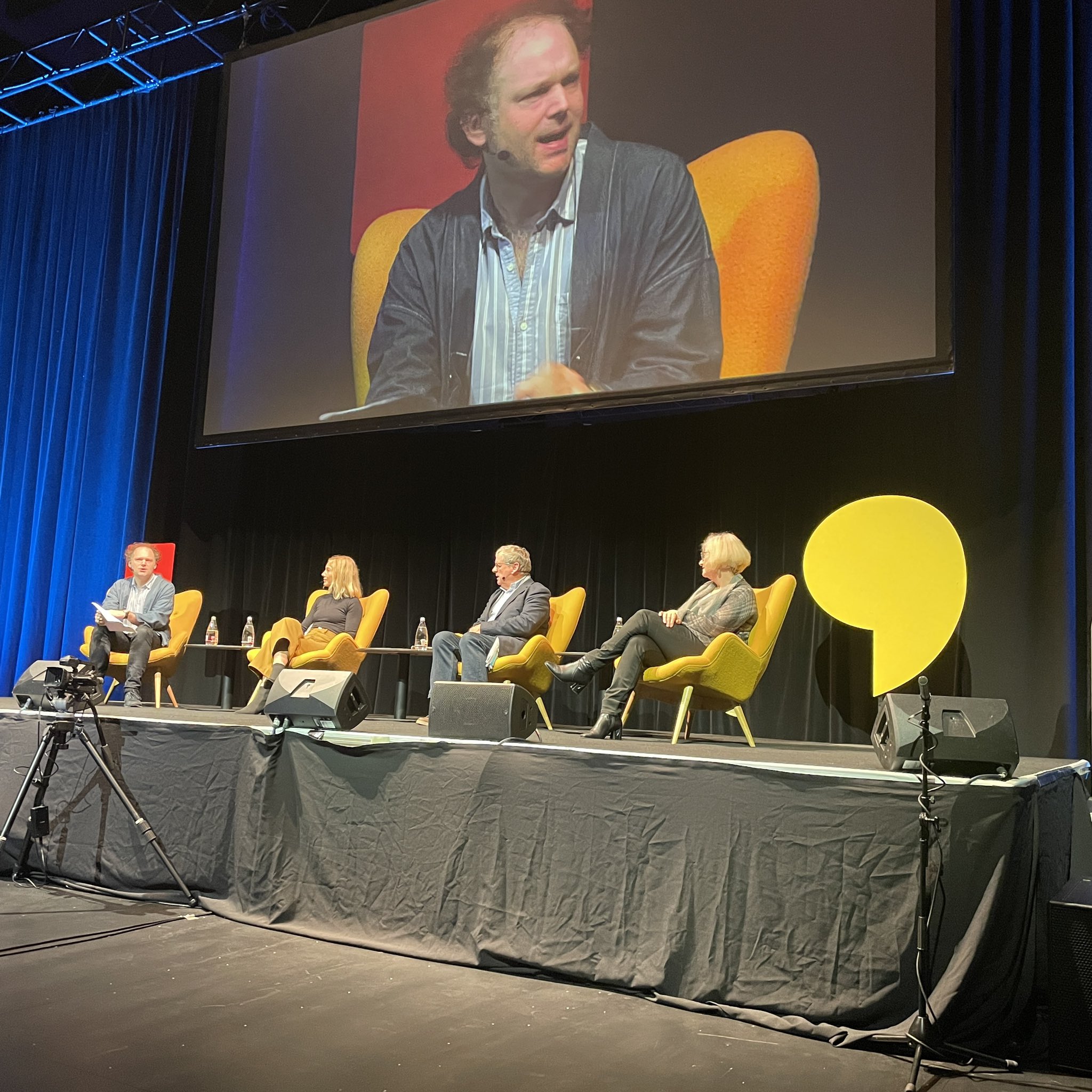
Erik Jensen, founding editor of The Saturday Paper, chaired this panel. Hannah Marshall, a partner at Marque Lawyers, was on hand to explain the legalities of defamation and the reforms needed to support public interest journalism. Investigative journalists Kate McClymont (SMH), best known for uncovering high profile scandals like Eddie Obeid, and Chris Masters (Four Corners) who is one of the journalists being sued by Ben Roberts-Smith, were able to give firsthand accounts of being defendants in defamation cases. 

While they could not speak about current cases, they were able to speak about past cases. McClymont spoke about Obeid, McLaughlin and other cases she has been involved in. McClymont and Masters spoke about the personal toll defamation actions take on journalists and their families. Masters exposed the corruption in the Queensland police force in a 1987 Four Corners program which lead to the Fitzgerald Inquiry on corruption in Joh Bjelke-Peterson's government. This also lead to a decade long defamation case against Masters and the ABC, which they eventually won but was exhausting for all involved.

Jensen said that as an editor, the defamation laws stand between the public and the truth. The panel spoke about the chilling effect that defamation actions can have on journalists and how they have had to learn how to do things differently to protect sources (e.g. using coding in their notes), and the importance of getting multiple on-the-record sources to confirm before publication. McClymont said that you need to approach stories as though you need to prove them in a criminal court. The costs of defamation can be crippling, with Masters arguing that the costs are leverage and that 'economic principles outweigh editorial principles'.

Marshall spoke about some of the reforms proposed to defamation law in an effort to be more balanced. She said that in Australia the balance is in the favour of the plaintiff, making it difficult and costly to defend a case. Often times the cases are brought about by a 'whiff of criticism' but the case itself can do more harm to the plaintiff's reputation than the original story which gave rise to the complaint.

Overall, a great session with lots of thought-provoking discussion. 

Radical Inclusive Rebellious

We bought rush tickets to see this fantastic session. Gamillaroi/Torres Strait Islander actor and writer Nakkiah Lui brought together a panel to showcase authors she is publishing under her new imprint Joan Press. Joan is named after Lui's grandmother, a storyteller and mentor, who was the 'person who taught me not to be invisible'. As such, Joan Press has been created to publish voices who are often excluded from storytelling. Lui introduced two authors who read from their works. 

Maddie Godfrey is a poet who has performed at the Sydney Opera House, the Royal Albert Hall and St Paul's Cathedral. Their debut poetry collection is How To Be Held (2018) and Joan will publish the forthcoming Dress Rehearsal. Maddie read a number of poems, including one titled 'Harry Styles is Interviewed on a Beach, and the Horizon Aligns with his Sighs'.  [After the session my festival friend and I were approached by an elderly man who wanted to know who Harry Styles was - we did our best to explain.]

Cartoonist and graphic artist Sarah Firth shared her debut work - a collection of graphic essays Eventually Everything Connects, which will be published by Joan. As she read an except called 'Joie de Vivre' aloud, we were able to see the Joie de Vivre illustrations on her website. Firth was delighted to be picked up by Joan, as other publishers rejected the book as it could not be easily categorised.

Sessions like these are fantastic for introducing new authors. I am so pleased we attended.

I was wrong

Our last session for the festival was about changing your mind and admitting your mistakes, especially in a culture which discourages confessing errors. Four speakers were invited to share where they were wrong about something and what they had learned.

Writer and performer Paul McDermott spoke first. He was absolutely hilarious and admitted that he has wasted much of the past three years writing songs about how much he hates Scott Morrison. He sang verses from a number of his songs, including 'Scomo no homo' to the laughter of all present. While humorous, his presentation reminded us of all the missed opportunities and failures of the previous government.

Professor Marcia Langton spoke next. Langton is widely respected for her work on Indigenous issues, having been involved in many government policy reforms over decades of activism. Her presentation was heartbreaking as she listed all of the enquiries and investigations she had been part of that she thought would lead to change. For example, she genuinely believed that the 1980s Royal Commission Into Aboriginal Deaths in Custody would lead to substantive change, but she was wrong as few recommendations were enacted. She said the same of the Stolen Generations reports, juvenile justice inquiry and many more. Langton was also involved in the Uluru Statement from the Heart. She concluded with her hope that new Prime Minister Anthony Albanese will adopt this statement and that she will not be wrong. 

Author, activist and feminist, Jane Caro, delivered an impromptu speech on various times she was wrong. Warm and witty, Caro spoke about the need to reflect and change your mind. Caro was followed by David Marr, one of my favourite thinkers and writers. Marr argued that  'a frank admission of error is an important thing' and spoke about how the press and the public are so quick to see a change of mind as weakness. He spoke about the Morrison government and their targeting of marginalised people (e.g. trans youth). He also spoke about some of the mistakes he had made as a young journalist and what the errors taught him.


Well, that was the end of my time at this year's Sydney Writers' Festival. It was great to be back, attending events like this, after living like a hermit for the past two years. With COVID precautions in place, respected by most attendees, I was able to safely attend and feel relaxed in the space. I come home with many memories and a stack of books to read. Special thanks to my festival friend for being a great companion and choosing such good sessions.

Read more about my time at the Sydney Writers' Festival here:
  • Day 1 - Includes Sean Kelly, Judith Brett, Jackie Huggins, Melissa Lucashenko, Sarah Krasnostein, Richard Fidler, Sisonke Msimang and Clare Wright
  • Day 2 - Includes Barrie Cassidy, Jennifer Down, Hannah Kent, Garry Disher, Damon Galgut and Larissa Behrendt
  • Day 3 - Includes Chris Masters, Kate McClymont, Nakkiah Lui, Marica Langton, Jane Caro and David Marr


Sydney Writers' Festival 2022 - Day Two

Joined by my festival friend, we saw four sessions on Saturday 21 May 2022

Barrie Cassidy and Friends: Election 2022

When this session was pitched, organisers had expected the federal election would have been held the week prior, so Barrie Cassidy and his panel of eminent journalists could dissect the outcome. As it happens, it was held on the morning of Election Day so the session was more speculative.

Cassidy was joined by Fran Kelly (ABC), Niki Savva (SMH) and Amy Remeikis (The Guardian) for an interesting discussion about the election, the leading candidates and the media.

They began with seminal moments in the campaign and spoke about Albanese forgetting the employment figures during week one, Morrison's crash tackle of a child on a soccer pitch, and the Catherine Deves retraction. I greatly admire Savva's analysis of Morrison's character and his poor performance as prime minister. 


Amy Remeikis, who is one of my favourite people on the planet, spoke about the rage she still feels at Morrison over his inability to understand the anger of women at his lack of empathy for Brittney Higgins, and his failure to engage with women's issues unless his wife explains them first. Remeikis spoke about the rise of the independents who have come to the fore due to the decade of inaction on climate change and Morrison's failure to govern.  

While much of the panel's focus was on the six week campaign, Cassidy brought them back to the fact that the election is not about the campaign but about the three years that preceded it. The panel was highly critical of the Morrison government's achievements in office. 

There was a lot of discussion about the role of the media in the campaign. Cassidy was scathing about the bias of Murdoch press. The panel talked about the gotcha questions, the debates and about the travelling press pack. There was a real sense of disappointment in the media coverage and a need for a post-mortem to unpack how the media can improve for future campaigns.  

It was excellent to see Barrie again (I miss him on Insiders!) and this panel was a great start to the day.

Jennifer Down and Hannah Kent

I am a huge fan of Australian author Hannah Kent. Her novels Burial Rights (2013), The Good People (2016) and most recently Devotion (2021) are such beautifully written stories. I admire the way she blends historical facts in her fiction to craft compelling narratives.

Kent was appearing in a few sessions at the Sydney Writers Festival, but I chose this one as she was appearing with Jennifer Down, author of Bodies of Light (2021) which was shortlisted for this year's Stella Prize.

Susan Wyndham asked these authors about the pressures of writing their third book (as so often the second book causes the most challenge). Both authors said that writing their current novels was very much like a debut. Kent described the process of writing Devotion and how it took so much longer than she expected as during the period between books two and three she became a parent. 

Down talked about the challenge of writing her novel when she works full-time, so she crams her research and writing of this book in her leisure time. Given the difficult subject matter of her novel, this meant spending her down-time in some dark places exploring the impact of trauma.

I found this session fascinating as they described the research they undertake to underpin their novels. Down explained her approach is very much like a magpie or bower bird, collecting random bits of material until she finds something that sends her on a path to follow. Similarly, Kent does extensive research. When she found a ship captain's firsthand account of travelling to Australia on the Zebra in 1838 she was inspired and ended up setting a third of her book on the voyage.

After the session I spoke to Hannah Kent while she signed my copy of Devotion

Small Towns, Big Secrets

We had a gap in our program so my festival friend and I bought rush tickets to attend this session, not knowing the authors. Dr Kate Evans (ABC) chaired the panel of Australian crime novelists including Garry Disher, Hayley Scrivenor and Dinuka McKenzie (who was a delightful last minute replacement for Aiofe Clifford). 

Dinuka McKenzie is the author of The Torrent (2022), her recently published debut. Her book is set in a fictional town in northern NSW which is inundated by a flood. A heavily pregnant detective, a few weeks shy of starting maternity leave, investigates the death of a young man.

Hayley Scrivenor is a debut novelist of the newly published Dirt Town (2022). Set in a fictional town in NSW, the story revolves around a girl who goes missing on the way home from school and a detective who seeks to find out what happened. 

Garry Disher is an established crime writer best known for his Wyatt series, the Challis and Destry novels, and the Hirschhausen series. He is a three time winner of the Ned Kelly award. His latest novel is The Way it is Now (2021) is about a burnt out cop who has to investigate a crime, which brings back past memories.

Dr Evans began by asking the writers what attracted them to set their stories in small towns. Each author had created a fictional town based on real places they were familiar with so they could infuse their stories with rich depictions of the landscape. Each author gave a description of their fictional town and told a bit about the story they had written.

Disher talked about how many crime novels are rooted to place. For example Ian Rankin's Rebus series is deeply Edinburgh and Michael Connelly's Bosch series is completely Los Angeles. Disher explained that in his novels, and those of many other Australian writers (including the panelists, Jane Harper, Chris Hammer, Sarah Bailey etc), feature investigators that are either outsiders or are people who have left the community and then returned, creating a tension with locals as they are seen as not belonging. 

This was an interesting session and it was lovely to be introduced to new authors. I really enjoy Australian crime novels and while I await the next Harper/Hammer/Bailey, I now have new titles to explore. [I am currently on holidays and have started reading Bitter Wash Road - the first in Disher's Hirschhausen series.] 

Limits of Imagination

Our last session for the day was on representation and creativity: Who has the right to tell certain stories? Sisonke Msimang chaired the panel which featured Aboriginal writer, filmmaker and lawyer Professor Larissa Behrendt (After Story), Chinese/American/Australian author Paige Clark (She is Haunted) and 2021 Booker Prize winner South African Damon Galgut (The Promise).

This was a fascinating discussion, at times uncomfortable, with panelists debating whether questions of the right of representation inhibit the creative process. Should authors only write what they know? If so, does that limit creativity?

Galgut spoke about how if he wrote a character of a different culture/gender/background to his, he should be judged on the quality of the portrayal and if it came across as inauthentic or implausible he should be critiqued, but he should not be barred from attempting to write about difference. Galgut talked about how every book you read gives you another version of the world. The audience roared with laughter when he said 'you can tell which of our politicians and leaders read books'.

Clark talked about how her collection of short stories feature characters that are like her, but said that ten years ago she may not have been able to write this as she would not have had the same opportunities.

Berhendt spoke about how for so long First Nations people have been denied a voice and have been written about by non-Aboriginal authors, portrayed as caricatures. She spoke about the current renaissance of First Nations authors and how important it has been for these authors to write their stories.

Sisonke Msimang asked really insightful questions and addressed head on the issue of white men's anxiety that diverse representation in literature makes less room for them. Msimang said, 'there might be some things to lose, but it doesn't have to be a loss.' Indeed there is far more to gain from diverse voices instead of cultural appropriation.

I really enjoyed this panel. It was challenging, thoughtful and considered. After hearing Larissa Behrendt speak about her novel After Story, I am really keen to read it. Following the session I spoke with Damon Galgut as he signed a copy of The Promise for me.


That's a wrap of Day Two of my SWF. Time to race home and watch the election results, before coming back for the final day tomorrow.

Books in my collection signed by authors today:
  • Damon Galgut - The Promise
  • Maxine Beneba Clarke - How Decent Folk Behave
  • Hannah Kent - Devotion

Read more about my time at the Sydney Writers' Festival here:
  • Day 1 - Includes Sean Kelly, Judith Brett, Jackie Huggins, Melissa Lucashenko, Sarah Krasnostein, Richard Fidler, Sisonke Msimang and Clare Wright
  • Day 2 - Includes Barrie Cassidy, Jennifer Down, Hannah Kent, Garry Disher, Damon Galgut and Larissa Behrendt
  • Day 3 - Includes Chris Masters, Kate McClymont, Nakkiah Lui, Marica Langton, Jane Caro and David Marr

Thursday, 26 May 2022

Sydney Writers' Festival 2022 - Day One

For the first time since 2019, I have attended the Sydney Writers' Festival, attending ten sessions over the three days. It was great to be back, with this my first major event outing since COVID began. 

Here's a run-down of my first day at the Festival - Friday 20 May 2022  

The Theatre of Politics

I was keen to attend this session with Emeritus Professor of Politics, Judith Brett, and journalist Sean Kelly, author of The Game, perhaps the best portrait of a politician I have ever read.  Essayist James Ley led them in a discussion about the performance of politics. 

They spoke about the rise of television and how this has brought about a change in the way politicians and the media behave. As Brett pointed out, before TV there were only grainy photos of politicians, viewed from a distance, and this served a different kind of leader. Now, leaders become characters and play a role. There is a public self and a private self, and a strong sense of performance. Social media has compounded this performance.

This session took place the day before the federal election, so there was the opportunity to compare and contrast Prime Minister Scott Morrison and Opposition Leader Anthony Albanese. 

Kelly spoke about how Morrison is a 'flat character' who portrays himself as a daggy dad who makes a weekly curry and loves the Cronulla Sharks. This manufactured image allows him to play PM - donning high vis and appearing in a succession of political stunts (tossing a ball, washing a woman's hair, welding!). When the real Morrison comes to the surface we see a petulant bully. They discussed how Morrison conceptualised the role of Prime Minister - not as a leader for everyone, but only as a leader for those who voted for him. He turned his back on the arts, the university sector, and others. 

In contrast, Albanese is not an alpha male, he is a different kind of politician. Brett and Kelly spoke about how Albanese was aiming for substance over style, looking for the greater good instead of self-interest. 

This was a really interesting discussion. Unfortunately the speakers were let down by the poor sound quality - crackling mikes, drop outs - that continued throughout the session.

But Not Forgotten 

In this session, Sarah Krasnostein, Jackie Huggins, Melissa Lucashenko and Clem Bastow paid tribute to writers who passed away in the previous year. Each delivered moving tributes which demonstrated the impact the author had on them.

Jackie Huggins spoke about bell hooks, who passed away in December 2021 at age 69. hooks wrote about race, class and gender and was influential in Huggins' life. As a young Aboriginal rights activist, Huggins was inspired by hooks' works Ain't I A Woman? (1981) and Feminist Theory: From Margin to Centre (1984). Huggins had the opportunity to meet hooks and interview her, and they formed a lifelong relationship. Huggins claims she would not have been able to write her landmark book Sister Girl (1998) had it not been for hooks. It was wonderful to hear this tribute. bell hooks was instrumental in my life as well, having read her works during my undergraduate women's studies degree. In particular I loved her writings on representation and popular culture like Outlaw Culture (1994) and Reel to Real (1996).

Miles Franklin Award winning author Melissa Lucashenko paid tribute to Keri Hulme who passed away on 27 December 2021. Hulme won the Booker Prize in 1985 for her debut (and only published) novel The Bone People. Lucashenko began by reading from Hulme's poetry collection Strands (1993) and spoke about how Hulme was an unconventional author who didn't fit the mould of a Booker Prize winning author and chose to follow her own path. She recounted a time when she met Hulme at a writer's festival a few weeks after Lucashenko had published her first work. After this session I spoke with Lucashenko while she signed a copy of Too Much Lip (2018) for me. I told her how I read her novel Steam Pigs (1997) when I first came to Australia and how much it meant to me.

Author Sarah Krasnostein spoke about the influence of Joan Didion, who died 23 December 2021 at 87 years of age. Best known for Slouching Towards Bethlehem (1968), The White Album (1979), Play it as it Lays (1970) and The Year of Magical Thinking (2005), Didion was a keen observer and intellectual. Krasnostein described Didion's ability to express time and place in her writing, and how she captured California and the cultural shifts of the 1960s and 1970s. After the session Krasnostein signed a copy of her book The Believer (2021) for me.

To wrap up this session, Clem Bastow paid tribute to songwriter and lyricist Stephen Sondheim who passed away on 26 November 2021. Sondheim write the lyrics to West Side Story (1957) and is best known for his musicals Company (1970), Follies (1971), Sweeney Todd (1979), Into the Woods (1987) and Assassins (1990). Bastow spoke about how she has autism and she used echolalia to repeat words from Sondheim's songs over and over again. Bastow sang examples from various songs to showcase the wit and complexity of Sondheim's lyrics. She was brilliant, funny and entertaining. I reckon Sondheim would have been chuffed with this tribute. 

Friends, Romans, Countrymen: Great Oratory and Speechifying

My final session for the day was on oratory and the importance of great speeches. Laura Tingle was unable to emcee this session as she was busy with the next day's election, so ABC's Sarah Kanowski took on this role. 

The three speakers - Richard Fidler, Sisonke Msimang and Clare Wright - were asked to present a speech that resonated with them. Professor Clare Wright was first up, and she donned an apron featuring the words to Julia Gilliard's misogyny speech which became known as the 'apron of truth' and was worn by each speaker as they delivered their speech. 

Professor Wright delivered a speech by Vida Goldstein in 1903. She was the first woman to stand for Parliament. The speech she delivered had a lot to say about political parties (Goldstein was an independent) and about women's suffrage.  Wright explained how this speech was not written, but she had transcribed it from media reports at the time. There were some uncomfortable parts of this speech, particularly in relation to race, but as Wright explained people we admire not be wholly admirable when viewed with a contemporary lens. It was a timely speech, delivered the night before independent Zoe Daniel won the seat of Goldstein, named after Vida, who was never elected despite multiple attempts but paved the way for generations of women. 

Richard Fidler has a keen interest in the history of the Czech Republic and has recently published The Golden Maze, a biography of Prague. He delivered a speech originally given by Vaclav Havel, President of Czechoslovakia on New Year's Day 1990 just after he was elected. Havel was a playwright who became the first democratically elected President after the fall of communism. In this speech he spoke frankly about the dark days that preceded his election and the realities that the country is facing. Havel told his people that they cannot blame the past regime for all their woes as they were complicit in allowing that regime to continue. There were eerie parallels with a speech that could be given today, and we did not then know that 24 hours after Fidler shared this speech we would have our own regime change in Australia.  The full text of the speech is available online.

The final speech chosen by Sisonke Msimang was Sojourner Truth's 1851 address 'Ain't I a Woman?' delivered to the Women's Rights Convention. Truth was born into slavery and she eventually escaped to freedom where she became an abolitionist and human rights activist. When the women's suffrage movement was gaining momentum in America, Truth's speech was a reminder to white women that they cannot win their rights by oppressing black women. Msimang delivered this speech in a moving and empowering way. Again, this speech had contemporary resonance as women are still fighting for equal pay, status and we have such a long way to go in addressing racial inequality.

Thoughts on Day One

It was great to be back at the Sydney Writers Festival for the first time since 2019. The COVID-safe protocols allowed me to feel relatively safe attending such an event - although admittedly I avoided attending anything at Town Hall as I am not ready for that big a venue yet. I attended solo today, but my festival friend is joining me on Saturday and Sunday.

The set up at Carriageworks has improved so much since the first SWF was held there years ago, when there were acoustic issues and so many events were held at the nearby Seymour Centre. While I still miss having the festival at Walsh Bay, it was nice to have the improved Carriageworks venue. The centralised book signings, food trucks and Glebebooks shop were great.

It was a cold and wet day in Sydney. On my way in to Carriageworks for the festival, despite an umbrella and raincoat, there was no way to keep dry. But fortunately, I had put all my books inside a wet bag so they survived the weather. 

Books in my collection signed by authors today:
  • Sean Kelly - The Game
  • Sarah Krasnostein - The Believer
  • Melissa Lucashenko - Too Much Lip
  • Chloe Hooper - Bedtime Stories
Unfortunately I missed Evelyn Araluen, but I am sure I will see her at a future event.


Read more about my time at the Sydney Writers' Festival here:
  • Day 1 - Includes Sean Kelly, Judith Brett, Jackie Huggins, Melissa Lucashenko, Sarah Krasnostein, Richard Fidler, Sisonke Msimang and Clare Wright
  • Day 2 - Includes Barrie Cassidy, Jennifer Down, Hannah Kent, Garry Disher, Damon Galgut and Larissa Behrendt
  • Day 3 - Includes Chris Masters, Kate McClymont, Nakkiah Lui, Marica Langton, Jane Caro and David Marr

Wednesday, 25 May 2022

Miles Franklin Award Longlist 2022

On 23 May 2022, the longlist was announced for Australia's most prestigious literary awards, the Miles Franklin Award, with twelve authors vying for the $60,000 prize. Richard Neville, Librarian from the State Library of NSW, said on behalf of the judges: 

“This year's longlist, drawn from a robust pool of entries, reflects the thematic richness and the formal adventurousness of the contemporary Australian novel, as our writers respond to our times. Diverse in every sense, it extends from world of realism to novels in a more experimental vein, proving that the nation's storytellers are continuing to test the boundaries of what the novel can do.” 
Let's check out the Longlist:

Michael Mohammed Ahmad - The Other Half of You
Bani Adam carries the weight of expectation. His family expects him to marry the right kind of girl and be the right kind of Muslim. But Bani wants to decide for himself, even if he makes mistakes or goes against the wishes of his family and faith. Ahmed's previous novel, The Lebs, won the 2019 NSW Premier's Multicultural Literary Award and was shortlisted for the Miles Franklin Award.

Larissa Behrendt - After Story
Jasmine is an Indigenous lawyer who takes her mother, Della, on a literary tour of England. This trip is an opportunity to bring them closer together and reconcile the past. When a child goes missing on Hampstead Heath, Jasmine recalls the disappearance twenty-five years ago of her older sister. Having heard Larissa Behrendt speak about this novel at the Sydney Writers Festival last weekend, I am keen to read it.


Michelle de Krester - Scary Monsters
This book is written in a flip format, where you read from the front to the middle one narrative, then flip the book over and read it the other way. The first narrative is by Lili, a South Asian migrant to Australia who is teaching in France in the 1980s. She worries about a creepy neighbour and the treatment of North African immigrants. The second narrative is by Lyle, who lives in a near-future radically right-wing Australia. He and his wife live in fear of repatriation so shun their past and embrace the consumerism and individualism of Australia. De Krester won the Miles Franklin Award twice previously: Questions of Travel (2013), The Life to Come (2018)

Jennifer Down - Bodies of Light 
Maggie Sullivan is institutionalised, growing up in a foster homes and group facilities after her father is jailed. Neglected and abused, by 19 she is diagnosed with depression and trauma. The novel follows Maggie into adulthood, when she is forced to encounter her long buried past.  I heard Jennifer Down speak at the Sydney Writers Festival last weekend and found her extremely impressive. While I reckon this will be a challenging novel, due to the subject matter, I am interested in reading it and becoming acquainted with this author.


Briony Doyle - Echolalia
Emma Cormac is struggling with her life and suffering postpartum depression. From the outside, she has everything anyone could ever want - a marriage to the stoic Robert, three small children and a prestige home. Emma's depression deepens, and when something happens to one of the children, Emma unravels. Doyle is the author of the novel The Island Will Sink and a memoir, Adult Fantasy.


Max Easton - The Magpie Wing
In this debut novel, Easton spans the 1990s to today in the suburbs and inner city of Sydney. Helen, Walt and Duncan are looking to escape their complex family histories and forge new lives for themselves as they enter adulthood. 


John Hughes - The Dogs
Hughes is the acclaimed author of The Remnants, Asylum, and most recently No One, which was shortlisted for the Miles Franklin Award in 2020. In The Dogs, Michael Shamamov is running away form life's responsibilities. His marriage has failed and he has barely seen his son or his ageing mother. A discussion with a nurse at his mother's nursing home leads him to realise that the needs to stop running away and instead reconnect. 

Jennifer Mills - The Airways
In 2019, Mills' novel Dyschonia was shortlisted for the Miles Franklin Award. In her latest novel, The Airways, she focuses on two characters Adam and Yun. Adam is a Greek-Australian living in Beijing. Adam is haunted by Yun's disembodied voice over something that happened between them years before. Described as a 'powerful, inventive and immersive novel' which unsettles 'the boundaries of gender and power, consent and rage, self and other, and even life and death'.


Alice Pung - One Hundred Days
Set in Melbourne in the 1980s, Karuna is the only daughter of an Australian man and a Philipino mother. When sixteen year old Karuna falls pregnant, her mother confines her to their fourteenth story housing-commission flat. Her mother wants to keep her safe and ensure she doesn't get into any more trouble. In the claustrophobia of her confinement, the mother-daughter relationship is at breaking point as they struggle for control. 

Claire Thomas - The Performance
Bushfires rage in the nearby hills, coating the city streets with ash. Three women attend a performance of a Beckett play. Margot is preoccupied by thoughts of her ailing husband. Ivy is distracted by a man snoring beside her. Summer can't concentrate as she is concerned about the safety of her girlfriend in the bushfire zone. By the time the curtain falls, they have a new understanding of their world. I bought this book on the recommendation of a friend, and have somehow never gotten around to reading it. Will make it a priority now. 


Christos Tsiolkas -
7 1/2 
Seeking solitude to write a book, a man arrives at a house on the coast. In the quiet, he recalls his childhood, his early experiences with sexuality. He tries to write a novel about Paul, an American former porn star who returns home to partake in an offer he cannot refuse. This autofiction is a mediation on beauty. Tsiolkas is the critically acclaimed author of seven novels including Barracuda and Damascus. He is best known for The Slap (2009), which was longlisted for the Booker prize.


Michael Winkler - Grimmish
In 1908 Italian-American boxer Joe Grim toured Australia, losing fights but winning fans who marvelled at his physical resilience. This genre-defying book unfolds through conversations between the narrator and his uncle. JM Coetzee called it 'The strangest book you will ever read this year'. Sounds intriguing...


At this stage I have not read any of these novels, but I do have several of these titles in the queue to be read.  Regardless, I will guess that the following authors will make the shortlist: Berhendt, Down, de Krester, Hughes, Thomas and Tsiolkas. 

The Shortlist will be announced 13 June 2022 and the winner will be revealed on 20 July 2022.