Monday, 30 May 2022
A Beautiful Mind
Saturday, 28 May 2022
Sydney Writers' Festival 2022 - Day Three
Joined by my festival friend, we saw three sessions on Sunday 22 May 2022. This was the day after the federal election, and while the full results were still being tallied, it was clear that the Morrison government had lost and that there would be a new Labor government. The whole day felt more hopeful and the election was clearly on the minds of many speakers as we looked forward to a new government and a kinder, gentler nation.
Where Angels Fear To Tread
Radical Inclusive Rebellious
I was wrong
Well, that was the end of my time at this year's Sydney Writers' Festival. It was great to be back, attending events like this, after living like a hermit for the past two years. With COVID precautions in place, respected by most attendees, I was able to safely attend and feel relaxed in the space. I come home with many memories and a stack of books to read. Special thanks to my festival friend for being a great companion and choosing such good sessions.
- Day 1 - Includes Sean Kelly, Judith Brett, Jackie Huggins, Melissa Lucashenko, Sarah Krasnostein, Richard Fidler, Sisonke Msimang and Clare Wright
- Day 2 - Includes Barrie Cassidy, Jennifer Down, Hannah Kent, Garry Disher, Damon Galgut and Larissa Behrendt
- Day 3 - Includes Chris Masters, Kate McClymont, Nakkiah Lui, Marica Langton, Jane Caro and David Marr
Sydney Writers' Festival 2022 - Day Two
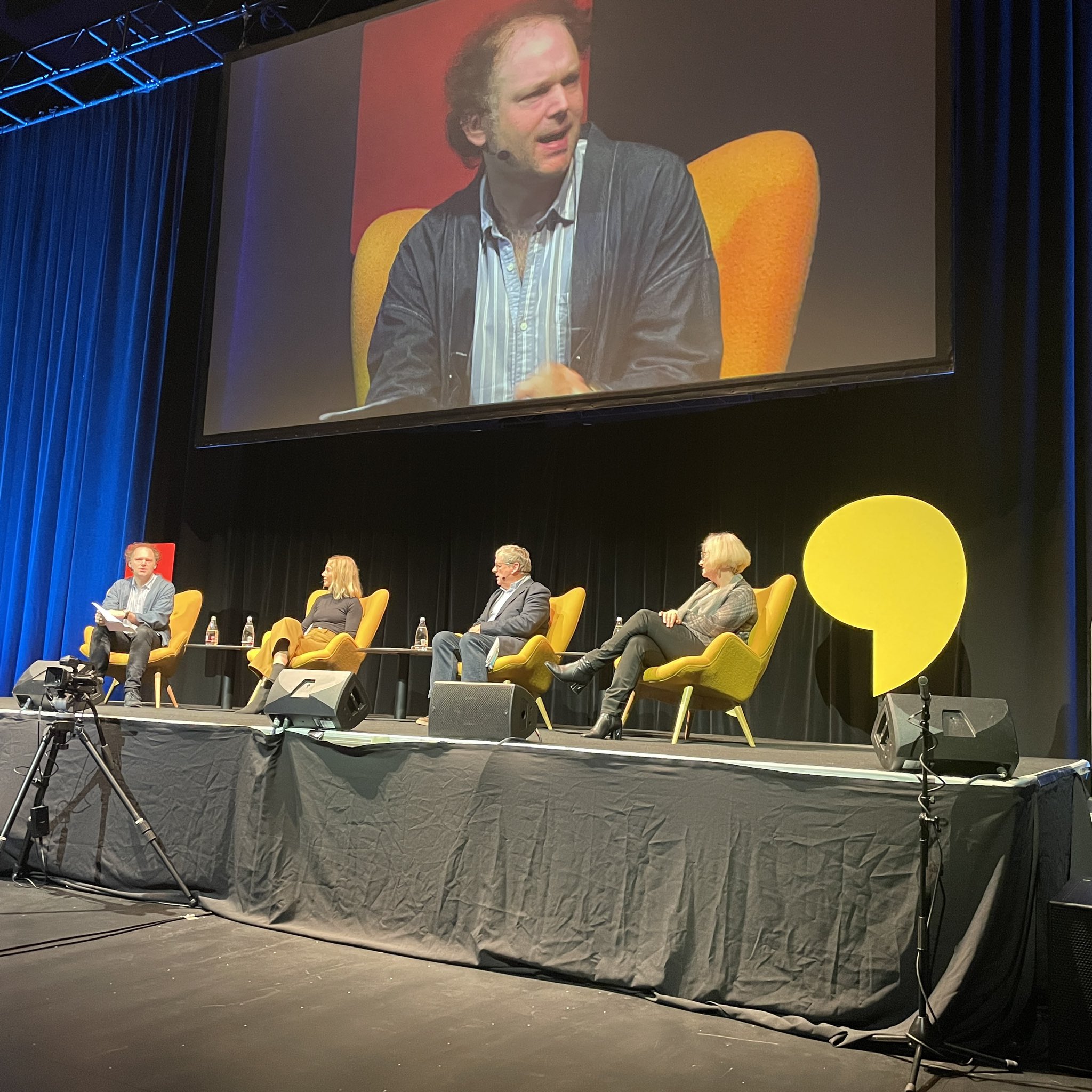
Joined by my festival friend, we saw four sessions on Saturday 21 May 2022
Barrie Cassidy and Friends: Election 2022
Jennifer Down and Hannah Kent
Small Towns, Big Secrets
Limits of Imagination
- Damon Galgut - The Promise
- Maxine Beneba Clarke - How Decent Folk Behave
- Hannah Kent - Devotion
- Day 1 - Includes Sean Kelly, Judith Brett, Jackie Huggins, Melissa Lucashenko, Sarah Krasnostein, Richard Fidler, Sisonke Msimang and Clare Wright
- Day 2 - Includes Barrie Cassidy, Jennifer Down, Hannah Kent, Garry Disher, Damon Galgut and Larissa Behrendt
- Day 3 - Includes Chris Masters, Kate McClymont, Nakkiah Lui, Marica Langton, Jane Caro and David Marr
Thursday, 26 May 2022
Sydney Writers' Festival 2022 - Day One
For the first time since 2019, I have attended the Sydney Writers' Festival, attending ten sessions over the three days. It was great to be back, with this my first major event outing since COVID began.
Here's a run-down of my first day at the Festival - Friday 20 May 2022
The Theatre of Politics
But Not Forgotten
Friends, Romans, Countrymen: Great Oratory and Speechifying
Thoughts on Day One
It was a cold and wet day in Sydney. On my way in to Carriageworks for the festival, despite an umbrella and raincoat, there was no way to keep dry. But fortunately, I had put all my books inside a wet bag so they survived the weather. - Sean Kelly - The Game
- Sarah Krasnostein - The Believer
- Melissa Lucashenko - Too Much Lip
- Chloe Hooper - Bedtime Stories
- Day 1 - Includes Sean Kelly, Judith Brett, Jackie Huggins, Melissa Lucashenko, Sarah Krasnostein, Richard Fidler, Sisonke Msimang and Clare Wright
- Day 2 - Includes Barrie Cassidy, Jennifer Down, Hannah Kent, Garry Disher, Damon Galgut and Larissa Behrendt
- Day 3 - Includes Chris Masters, Kate McClymont, Nakkiah Lui, Marica Langton, Jane Caro and David Marr
Wednesday, 25 May 2022
Miles Franklin Award Longlist 2022
On 23 May 2022, the longlist was announced for Australia's most prestigious literary awards, the Miles Franklin Award, with twelve authors vying for the $60,000 prize. Richard Neville, Librarian from the State Library of NSW, said on behalf of the judges:
“This year's longlist, drawn from a robust pool of entries, reflects the thematic richness and the formal adventurousness of the contemporary Australian novel, as our writers respond to our times. Diverse in every sense, it extends from world of realism to novels in a more experimental vein, proving that the nation's storytellers are continuing to test the boundaries of what the novel can do.”
Michael Mohammed Ahmad - The Other Half of You
Sunday, 8 May 2022
Colonial Correspondence
In 2020 Australian author Kate Grenville published A Room Made of Leaves, a fictionalised memoir of Elizabeth Macarthur. I enjoyed that novel and became very interested in Mrs Macarthur, as her life and contributions to early settlement life in Sydney were overshadowed by her husband John. He was a mercurial man, often regarded as the 'father of Australian wool', who put a great strain on his family through his long absences and difficult temperament.
Grenville's novel is a wholly fictional work, but the impetus for that book came from Elizabeth's own letters. Now, Grenville has compiled and edited a collection of Elizabeth Macarthur's Letters (2022) so that readers may hear from Elizabeth directly. In this selection, Elizabeth Macarthur writes to her mother and friends in England, later to her sons, and in reading these letters we better understand the challenges of Elizabeth's life in the early days of settlement.The Elizabeth Macarthur we come to know through her correspondence is a devoted mother and grandmother, keen botanist, and a shrewd business woman. Each letter is prefaced with a commentary from Grenville, often providing the context for writing or giving insight into how the letter related to Grenville's novel.
It must have been so daunting for young newlywed Elizabeth to contemplate moving from England and all she had known, to the far side of the world. In a letter to her mother dated 8 Oct 1789, she writes about how she tries to soften the blow of the great distance, telling her mother "...it is much the same, whether I am two hundred or more than many thousand miles apart from you."
Initially I was perplexed by this collection, preferring the fictional Mrs Macarthur to the one found in these letters. But as I read, I became more and more fascinated by both the woman and the letters themselves. The correspondence back and forth from England was the lifeblood of the community, read by the intended recipient and passed around to family and friends to give news of the colonies or homeland. As such, Grenville argues these letters may be a form of fiction too, wherein Elizabeth didn't share her true self, but a version of herself she chose to present.
Many of Elizabeth's letters detail the ships which carried correspondence back and forth - "I hope you will have received my letter, dated August 1790, which I sent by the Scarborough transport, by way of China" - or the person the letter has been entrusted to see safely delivered. Oftentimes letters are in response to ones received many months previously, or written in haste when a ship announces a sudden departure.
While I enjoyed reading many of these letters, it is her ones to her sons Edward and John which carry the most weight. In these letters she gossips about mutual acquaintances but also tells of their father's increasing mental illness. I knew John Macarthur was ill-tempered, but I didn't realise he suffered from debilitating depression. It would have been such a challenge for Elizabeth, especially as her husband worsens, when mental health was so misunderstood.
In a letter to her son John on 18 Dec 1826 she writes "Your dear father is gone to bed not in good spirits.... He is suffering again from one of those fits of despondency which are sure to succeed extraordinary exertion and over-excitement." The day before she had written to her son Edward, "You will observe from my letter to John that your dear father has had a severe attack of his old tormenting complaint, with all the accustoming attendants of despondency and low spiritless". As Elizabeth copes with her husband's 'gloomy apprehensions', the family suffer a tragedy when their son John dies in April 1831. Elizabeth had not seen him since he was a young child, sent back to England for schooling. The grief at this loss is evident in her letters and is only magnified by her husband's volatility.
I enjoyed reading this collection, especially having read Grenville's novel A Room Made of Leaves. It is wonderful to hear about Elizabeth's life in her own words.
Friday, 29 April 2022
Stella Prize Winner 2022
Using a mix of poetry and essay, Araluen critiques a nostalgic view of Australia. She explores language and identity, inviting readers to adopt a different perspective. The judges report that 'Araluen's brilliance sizzles when she goes on the attack against the kitsch and the cuddly: against Australia's fantasy of its own racial and environmental innocence.' She bears witness to the present, and hopes for a decolonial future.
The Chair of the Judging Panel, Melissa Lucashenko, said:
"When you read Evelyn Araluen's Dropbear you'll be taken on a wild ride. Like the namesake of its title, this collection is simultaneously comical and dangerous. If you live here and don't acquire the necessary local knowledge, the drop bear might definitely getcha! But for those initiated in its mysteries, the drop bear is a playful beast, a prank, a riddle, a challenge and a game. Dropbear is remarkably assured for a debut poetry collection, and I think we can safely say it announced the arrival of a stunning new talent to Australian literature."
Wednesday, 27 April 2022
Women's Prize Shortlist 2022
The 2022 Women's Prize shortlist has been announced! The six titles on the shortlist are:
- Sorrow and Bliss - Meg Mason
- The Island of Missing Trees - Elif Shafak
- Great Circle - Maggie Shipstead
- The Book of Form and Emptiness - Ruth Ozeki
- The Bread the Devil Knead - Lisa Allen-Agostini
- The Sentence - Louise Erdrich
Saturday, 23 April 2022
The Social Network
In 2010 Jennifer Egan won the Pulitzer Prize for her remarkable novel A Visit from the Goon Squad. It was unlike anything I had ever read. Egan cleverly played with form and style, creatively writing with wit and intellect. Each chapter was its own short story, with memorable characters who appear in each other's narratives. Linking these stories were themes of music and the passage of time. The sheer delight I experienced reading (and re-reading) Goon Squad was profound, a high I have been searching for ever since.
My cravings have been satisfied with Egan's latest novel The Candy House (2022). While not exactly a sequel to Goon Squad, it is more like a companion piece. Written in the same non-linear way, the interlinked chapters reconnect readers with beloved characters, woven in a tight tapestry that is only fully visible when you zoom out at the end.
Instead of the backdrop of music, technology is the temptation of The Candy House. Bix Bouton, founder of social media giant Mandala, has developed a new product called 'Own Your Unconscious' where you can download your entire memory bank to a cube and review past events you may have forgotten or not registered at the time. If you choose, you can upload all or parts of your memory to the 'Collective Consciousness' where others can view it. Even if you choose not to engage, you may appear in other people's memories of shared experiences. While some characters engage willingly with these tools, others (like Chris Salazar and his company Mondrian) are 'eluders', fighting against this loss of privacy, endeavouring to disrupt invasive technology. While this may sound like a dystopian sci-fi story, it is actually a tautly written meditation on human connection.Egan has an incredible ability to write in a diverse range of styles. One chapter is written as a series of emails between a number of different characters. Another is as an instruction manual to a field agent on a mission. We learn of the 'algebraization' of people's experiences, and the way in which human behaviour can be counted, predicted and compartmentalised. We learn about language, the 'word-casings' of overused words that have lost all meaning. While some styles and chapters worked better for me than others, I loved becoming reacquainted with characters like Sasha, La Doll, Lulu, Lou, Lincoln and more, as we explored the near future in the digital age.
Saturday, 9 April 2022
To Have and Have Not
I first heard about Miranda Cowley Heller's debut novel, The Paper Palace (2021) a few weeks ago when it was longlisted for the Women's Prize. Reading a brief synopsis, it sounded like it was the story of a love triangle, which didn't really interest me. But then I read a rave review, so I decided to read the first chapter and see if it was worth my time. I am so glad I did as The Paper Palace is a wonderfully engrossing novel.
Thursday, 31 March 2022
Stella Prize Shortlist 2022
The 2022 Stella Prize Shortlist has been announced! The twelve nominees have been whittled down to six finalists in the running for this important literary award.
The 2022 shortlist is as follows:- Evelyn Arluen - Drop Bear
- Eunice Andrada - Take Care
- Jennifer Down - Bodies of Light
- Lee Lai - Stone Fruit
- Elfie Shiosaki - Homecoming
- Anwen Crawford - No Document
“The 2022 Stella Prize shortlist is big on emerging voices writing in unconventional ways - from regions, positions and literary forms that transcend the mainstream. These authors are writing back, insisting that 'other' lives - First Nations lives, poor women's lives, queer lives and Filipina lives - matter on the page, just as they do in everyday affairs.”
Saturday, 26 March 2022
The Colour and The Shape
On 24 January 2000 my brother Mark and I saw the Foo Fighters on their 'There is Nothing Left to Lose' tour at the Metro theatre in Sydney. The Metro is a great venue for gigs, small enough that fans can get up close to the stage, and large enough to enjoy the atmosphere of a like-minded crowd. Mark and I would rush down to the stage front to thrash and head-bang to our favourite songs, then retreat to the back to catch our breath, before lunging into the crowd once more. It was an awesome concert, solidifying my love of the Foo Fighters, and creating a memory of an incredible shared experience with my brother.
It was no surprise then, that Mark gave me Dave Grohl's The Storyteller (2021) for Christmas - a perfect gift. Subtitled 'Tales of Life and Music' Grohl tells stories about his lifelong passion for music from his childhood, through to his days with Scream, Nirvana, the Foo Fighters and Them Crooked Vultures.Sunday, 13 March 2022
A League of Her Own
The League of Nations was founded in 1920 following the Paris Peace Conference at the end of the First World War. Based in Geneva, the League aimed to prevent wars through disarmament, resolution of disputes between nations and collective security. Despite its promise, The League of Nations was ultimately ineffective, failing to prevent several conflicts, including the second World War. It was replaced in the 1940s by the United Nations. I hadn't given much thought to the League since my undergraduate days, but memories of my studies came flooding back as I read Frank Moorhouse's remarkable novel Grand Days (1993).
In this fictional account of the League's early years, plucky young Australian Edith Campbell Berry travels to Geneva to take up a role in the newly established organisation. On the train from Paris she meet Major Ambrose Westwood, a British officer at the League. Their flirtation over dinner is the start of a fascinating relationship. Edith is determined to live according to her morals and has created a list of rules to live by which guide her behaviour (such as the 'Way of Companionable Confession' in which one tells a minor confession to someone in order to bring them into closer confidence). Over time Ambrose challenges her thinking by introducing her to 'Weimar' experiences like underground night clubs, which expose Edith to other ways of being.Edith is an idealist who has tremendous faith in the League's ability to bring about world peace. Throughout the novel she mixes and mingles with characters both fictional and real. She works closely with Sir Eric Drummond, Secretary-General (1919-1922), was mentored by John Latham (Australian politician), had her image drawn by Hungarian caricaturist Emery Kelen, and has an opportunity to hear a lecture by birth control advocate Margaret Sanger. This blending of fact and fiction brings the story to life and is a testament to Moorhouse's extensive research.
Edith's commitment to her organisation extends to her designing of uniforms for League staff, and creating stationary and document holders for meeting attendees - which promptly get stolen as keepsakes by delegates, much to her chagrin. But her commitment often blinds her to the League's failures, and Moorhouse does a great job of explaining how things work in this bumbling bureaucracy.
The novel has much wry humour, often in the form of witty dialogue, and Edith finds herself in some strangely comical predicaments. But Grand Days also has darkness as nationalism is on the rise in parts of Europe. Modern readers will find the racism and sexism of the 1920s confronting, but also concerning as these sentiments echo a hundred years later.
Grand Days also follows Edith's sexual awakening. Her relationship with Ambrose challenges her traditional views. Impromptu encounters with a black jazz musician in Paris and a provocative woman spark her curiosity. She also experiences sexual violence when a club she visits is raided. These encounters allow the author, through Edith, to reflect on race, eugenics, sex and sexuality.
Moorhouse has crafted a coming of age story which shows the evolution of a woman, of Australia and of an international institution. It is quite remarkable how he has inserted Edith into real events to explore 1920s Europe.
I greatly enjoyed reading Grand Days. At almost 700 pages it does take some commitment, but it is well worth the journey. I would recommend it to anyone interested in this fascinating time in history. Reading it against the backdrop of war once again in Europe, the failures of diplomacy, and the rise of nationalism, one wonders what Edith would think today.This book has been on my 'to be read' list since 2016 when I met Frank Moorhouse at the Sydney Writers Festival. During that session he was speaking about his admiration of George Eliot (also a favourite of mine) and how well Eliot would have got on with Edith. When he signed a copy of Grand Days for me we spoke about the trilogy and he said that people often just read the sequel Dark Palace, so he was pleased that I was starting at the beginning. He said he hoped I would enjoy it. Well, Frank, I certainly did. Thank you!
The Edith Trilogy consists of Grand Days (1993), Miles Franklin Award Winner Dark Palace (2000) and Cold Light (2011). I am definitely intrigued to follow the adventures of Edith Campbell Berry and look forward to continuing this series.


